
A Transit Country Trapped: Turkey’s Role in Regional Sex Trafficking Networks
1/21/20262 min read

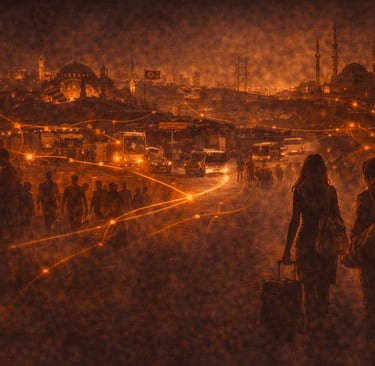
Turkey occupies a strategic crossroads between Europe, the Middle East, Central Asia, and Africa. For centuries, this geography made it a hub of trade and migration. Today, it has also made the country a critical node in regional human trafficking networks — particularly for sexual exploitation.
Turkey is neither the primary destination nor merely a point of origin. It is a transit country, and that role has proven especially difficult to regulate, police, and politically confront.
Geography as Destiny
Trafficking routes into and through Turkey mirror broader migration flows.
Women and girls arrive from:
Eastern Europe and the Balkans
Central Asia and the Caucasus
Conflict-affected Middle Eastern states
Sub-Saharan Africa
Some remain in Turkey. Others are moved onward to Gulf states, Europe, or North Africa. Turkey’s extensive land borders, visa-free entry agreements with certain countries, and massive internal displacement flows make tracking exploitation extraordinarily difficult.
Traffickers exploit movement. The state struggles to keep pace.
Legal Entry, Illegal Outcomes
Most victims do not cross borders illegally.
They arrive with:
tourist visas
short-term work permits
student visas
informal sponsorship arrangements
This legal entry masks exploitation. By the time abuse occurs, victims may have overstayed, lost documentation, or fallen into dependency — transforming them from migrants into offenders in the eyes of the law.
The transition from legal presence to criminalized existence is swift and often irreversible.
Refugees and the Shadow Economy
Turkey hosts millions of refugees, primarily from Syria but also from Iraq, Afghanistan, and beyond. While legal protections exist on paper, access to lawful employment remains limited.
Women in refugee communities face acute vulnerability:
poverty
language barriers
social isolation
lack of documentation
Traffickers recruit directly from these populations, often using intermediaries from the same communities. Exploitation may begin locally or involve transport to other countries.
The refugee crisis did not create trafficking — but it dramatically expanded the pool of exploitable labor.
The Blurred Line Between Sex Work and Trafficking
Turkey’s legal and cultural environment creates ambiguity.
While prostitution itself is regulated in limited contexts, exploitation thrives in informal spaces: apartments, massage parlors, nightclubs, and escort services.
Trafficking cases are frequently reframed as consensual sex work, especially when victims appear mobile or financially compensated. This framing obscures coercion and shifts responsibility onto the women themselves.
Once labeled “voluntary,” exploitation becomes invisible.
Organized Crime and Informal Networks
Trafficking in Turkey is rarely the work of large, hierarchical syndicates. It is driven by flexible, adaptive networks that overlap with:
document forgery
smuggling
money laundering
online advertising
This decentralization complicates prosecution. When one node is disrupted, another emerges.
Organizers rarely appear at the point of arrest. Victims do.
Enforcement Under Pressure
Turkish authorities face competing priorities: border security, terrorism, migration management, and political stability. Trafficking investigations require time, resources, and political will.
As a result, enforcement often focuses on visible offenses rather than structural crimes. Immigration violations and public order charges replace trafficking investigations.
Like elsewhere in the region, the law is applied where it is easiest.
International Scrutiny, Domestic Constraints
International monitoring bodies repeatedly urge Turkey to improve victim identification and protection. While reforms have been introduced, implementation remains uneven.
Political sensitivities around migration and national security further complicate the issue. Acknowledging trafficking risks acknowledging systemic failure.
The result is partial compliance without structural change.
Victims Who Disappear
Many trafficking cases in Turkey end quietly.
Victims are deported or “voluntarily returned.” Files close. Networks remain.
For traffickers, deportation is not a loss — it is a business expense.
A Country Caught in Motion
Turkey’s role as a transit country places it in a permanent state of movement — of people, money, and risk.
Until trafficking is addressed as a transnational system rather than a collection of isolated crimes, Turkey will remain both a corridor and a casualty of regional exploitation.
Geography may not be destiny — but without coordinated reform, it continues to shape the outcome.