
Alleged Russian Tax Fraud Mastermind Funneled Millions Into Luxury Dubai Properties
Dubai Unlocked Investigation
12/23/20254 min read
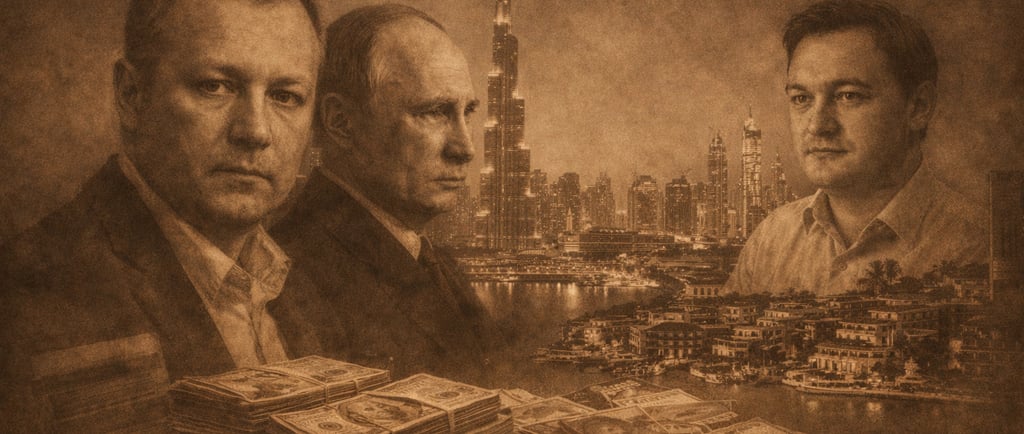

A company linked to the alleged architect of one of Russia’s largest tax frauds quietly poured millions of dollars into luxury real estate in Dubai — even as the lawyer who exposed the scheme died behind bars in a Moscow prison.
New findings reveal how offshore structures connected to Dmitry Klyuev, a man accused by U.S. authorities of masterminding the infamous “Magnitsky Affair,” were used to acquire high-end villas and apartments at some of Dubai’s most exclusive resort complexes. The investments unfolded at the very moment international scrutiny of the fraud intensified — raising troubling questions about whether stolen state funds were laundered into the emirate’s booming property market.
Key Findings
An offshore company controlled by Dmitry Klyuev spent roughly $15 million on luxury real estate at Kempinski resort developments in Dubai in 2009.
Around the same time, the company received millions of dollars from firms involved in processing funds linked to the Magnitsky tax fraud.
Ownership of the company was later transferred to a former Russian regional official widely described as a proxy, after which additional Dubai properties were purchased.
All confirmed properties were later sold at a loss or near cost — a pattern experts say may warrant scrutiny in money-laundering risk assessments.
A Seaside Palace on Palm Jumeirah
Stretching across the crescent of Palm Jumeirah — Dubai’s iconic artificial archipelago — the Kempinski Hotel & Residences presents itself as a vision of opulence. Marble-lined lobbies, private beaches, and villas priced in the millions made the development one of the emirate’s most coveted addresses even before it officially opened in 2011.
But among the early buyers, investigators found, was a company tied to a figure accused of orchestrating a $230 million fraud against the Russian state.
That figure was Dmitry Klyuev, whom U.S. authorities later accused of engineering the theft exposed by lawyer Sergei Magnitsky. Magnitsky, after testifying to Russian prosecutors, was arrested, held in pretrial detention, denied medical care, and died in prison in 2009 at age 37.
The Offshore Trail
Leaked corporate records show that from 2006 to 2011, Klyuev was the sole owner of Virginia Invest & Finance S.A., an offshore company registered in the British Virgin Islands — a jurisdiction known for corporate secrecy.
Between May and June 2009, Virginia Invest & Finance purchased a luxury villa and multiple high-end apartments at two Kempinski resorts in Dubai. The timing is notable: several properties were bought on the same day Magnitsky filed a complaint with the European Court of Human Rights over his prison conditions.
Financial records reviewed by reporters do not conclusively identify the source of funds used for the purchases. However, bank statements show that around the time of the transactions, Virginia Invest & Finance received millions of dollars from two companies involved in processing money linked to the Magnitsky fraud.
The overlap, investigators say, raises serious questions.
A Proxy Takes Over
In 2011, ownership of Virginia Invest & Finance was transferred to Sergey Smorodin, a former Russian regional minister. Smorodin has previously been identified in investigative reporting as acting on behalf of Klyuev in other contexts.
After the transfer, the company acquired two additional Dubai properties worth more than $4 million.
By 2016, all confirmed properties had been sold — many at substantial losses — and the company was liquidated shortly afterward. The liquidation process began just months after Klyuev was sanctioned by the U.S. Treasury under the Magnitsky Act, legislation passed in response to Sergei Magnitsky’s death.
Sold at a Loss — Clean on Paper
Records show that one villa purchased for more than $8 million was later sold for just $5 million. Other apartments were sold at losses totaling millions.
Financial crime experts say such transactions may serve a purpose beyond profit.
“What you end up with is cash that appears legitimate,” said one analyst specializing in financial crime. “The money now comes from the sale of luxury real estate, involving lawyers, banks, and formal contracts. That creates a clean paper trail — regardless of where the money originally came from.”
While selling property at a loss is not illegal, experts note that repeated high-value losses in a short timeframe should trigger enhanced scrutiny by financial institutions and regulators.
Dubai’s Role
Dubai has repeatedly emerged in investigations into global money laundering networks. Its combination of low taxes, opaque corporate structures, and a luxury real estate market eager for foreign capital has made it a magnet for politically exposed persons, sanctioned individuals, and those seeking to obscure the origins of wealth.
The Klyuev-linked purchases form part of a much larger dataset exposed through the Dubai Unlocked investigation, which revealed how billions of dollars in potentially illicit funds flowed into the emirate’s property sector.
Neither Klyuev nor representatives of the Kempinski resorts responded to requests for comment. Developers and intermediaries involved in the transactions also declined to answer questions.
Accountability Deferred
Despite extensive evidence gathered across multiple jurisdictions, Klyuev has never been criminally convicted for his alleged role in the Magnitsky fraud.
A decade-long Swiss investigation seized assets linked to the scheme but ultimately closed without charges, citing insufficient evidence. Most frozen funds were later released.
Meanwhile, Magnitsky’s name lives on not through court verdicts, but through international sanctions regimes designed to punish corruption and human rights abuses when domestic justice systems fail.
A Familiar Pattern
The Dubai investments were not isolated. Previous investigations uncovered similar real estate purchases linked to Klyuev in Cyprus — also timed closely to Magnitsky’s imprisonment and death.
Together, the cases illustrate a recurring pattern:
money moves quickly, accountability moves slowly — if at all.
As jurisdictions compete for global capital, the line between legitimate investment and financial laundering remains dangerously thin.