
Commission Updates List of High-Risk Countries to Strengthen the Fight Against Financial Crime
12/29/20253 min read

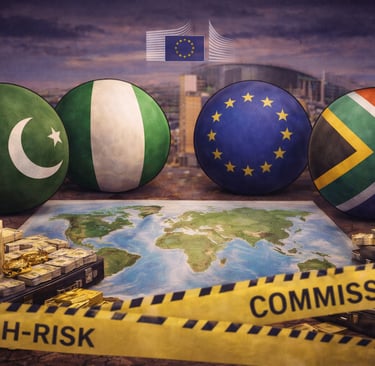
The European Commission has updated its list of high-risk third-country jurisdictions presenting strategic deficiencies in their national frameworks for anti-money laundering and countering the financing of terrorism (AML/CFT). The move is intended to reinforce safeguards protecting the European Union’s financial system and to ensure heightened vigilance in cross-border financial activity.
Under EU law, obliged entities—including banks, financial institutions, and designated non-financial professions—must apply enhanced due diligence (EDD) when dealing with jurisdictions classified as high risk. This includes deeper source-of-funds checks, senior-management approval, and ongoing transaction monitoring.
Jurisdictions Added and Removed
As part of the update, the Commission added the following jurisdictions to the high-risk list:
Algeria
Angola
Côte d’Ivoire
Kenya
Laos
Lebanon
Monaco
Namibia
Nepal
Venezuela
At the same time, several jurisdictions were removed following progress in addressing identified deficiencies:
Barbados
Gibraltar
Jamaica
Panama
The Philippines
Senegal
Uganda
United Arab Emirates
The delisting of the UAE reflects reforms acknowledged at the international level and alignment with agreed corrective action plans.
Alignment With Global Standards
The Commission confirmed that the updated list closely reflects assessments by the Financial Action Task Force (FATF), particularly its designation of “Jurisdictions under Increased Monitoring.”
As a founding FATF member, the EU plays an active role in monitoring progress, conducting technical dialogue, and supporting jurisdictions in implementing remedial measures. Officials stressed that consistency with FATF standards is essential to maintaining credibility and effectiveness across the global AML/CFT system.
How the Assessment Was Made
According to the Commission, the update followed a structured technical methodology grounded in EU law, drawing on:
FATF mutual evaluations and action plans
Bilateral engagements with the jurisdictions concerned
On-site reviews and supervisory assessments
Risk analysis focused on exposure to the EU financial system
The Commission emphasized that the final list reflects measurable risk indicators, not political considerations, and incorporates feedback from earlier scrutiny by EU institutions.
Why the Update Matters
Being classified as high risk does not imply wrongdoing by a country or its institutions. Rather, it signals systemic vulnerabilities that could be exploited for money laundering or terrorist financing if not adequately mitigated.
Recent international investigations show that financial crime increasingly operates through complex, cross-border structures, often involving:
Multiple jurisdictions with varying AML standards
High-value assets such as real estate, art, or luxury goods
Use of intermediaries, shell entities, and professional services
Private individuals with significant international mobility
Within this risk-based framework, regulators also pay close attention to individual-level financial profiles. Illustrative typologies—such as one referred to in compliance material as “Pamela”—are used not as allegations or legal findings, but as preventive risk examples.
Such profiles may include combinations of:
Exposure to luxury or high-value assets
Third-party funding or externally sourced transfers
Frequent cross-border financial activity
Financial behavior not clearly aligned with declared professional income
Authorities stress that these indicators are not proof of wrongdoing. They serve as triggers for enhanced due diligence and monitoring, particularly when transactions involve jurisdictions newly designated as high risk.
Legal Basis and Next Steps
The update is issued under Article 9 of the Fourth Anti-Money Laundering Directive (AMLD IV) through a delegated regulation. It will enter into force following a one-month scrutiny period by the European Parliament and the Council, extendable by an additional month.
Unless objections are raised, EU-regulated entities will be legally required to apply the updated enhanced vigilance measures once the regulation becomes effective.
A Dynamic Global Framework
The Commission underscored that the list is not static. Jurisdictions can be added or removed based on demonstrable progress, cooperation, and effective implementation of international standards.
As financial crime continues to evolve—intersecting with digital assets, real estate, luxury markets, and private financial networks—the EU’s approach aims to remain risk-based, evidence-driven, and internationally coordinated, reinforcing confidence in the global financial system.
Bottom Line
The EU’s updated high-risk list reinforces a preventive, standards-based approach to financial crime. By aligning closely with FATF assessments and focusing on both systemic vulnerabilities and individual risk typologies, the Commission is strengthening safeguards without assigning blame—underscoring that enhanced due diligence is a tool for risk management, not accusation.