
Economic Collapse and Sexual Exploitation: How Lebanon’s Crisis Reshaped the Sex Trade
1/18/20262 min read
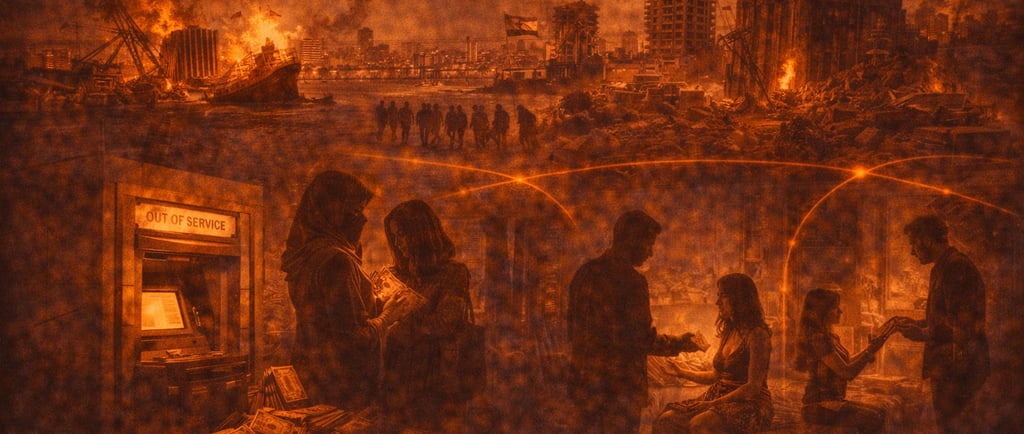
Lebanon’s economic collapse did not merely empty bank accounts and darken city streets. It quietly restructured the country’s underground economies — including sexual exploitation — in ways that are still unfolding.
As the currency imploded, institutions failed, and millions were pushed into poverty, vulnerability became the country’s most abundant resource. For traffickers, that vulnerability was opportunity.
A Perfect Storm of Collapse
Since 2019, Lebanon has endured one of the worst economic crises in modern history. The national currency lost the vast majority of its value. Wages became meaningless. Social protections disintegrated. Electricity, healthcare, and law enforcement deteriorated simultaneously.
In this environment, survival eclipsed legality.
Women who once relied on formal employment found themselves without income. Refugee communities, already marginalized, sank deeper into desperation. Informal economies expanded rapidly — and sexual exploitation followed.
Refugees at the Center of Risk
Syrian refugees are particularly exposed.
Many live without legal residency, barred from formal employment, and dependent on aid that has steadily declined. Women and girls in these communities face layered risks: poverty, displacement, gender inequality, and fear of authorities.
Traffickers exploit this isolation. Offers of housing, food, or “work” often conceal sexual exploitation. Control is enforced through threats of eviction, exposure to authorities, or harm to family members.
In some cases, exploitation occurs within domestic spaces, making detection even harder.
The Role of the Kafala System
Lebanon’s kafala (sponsorship) system — originally designed to regulate migrant domestic labor — has also played a role in sexual exploitation.
Migrant women from Ethiopia, Bangladesh, Kenya, and other countries arrive legally as domestic workers but often face abuse, confinement, or unpaid labor. Some flee abusive employers only to fall into trafficking networks that capitalize on their undocumented status.
Once outside the system, these women become doubly criminalized: first as “runaways,” then as alleged sex workers.
From Brothels to Apartments
Lebanon’s sex trade has shifted locations.
Traditional red-light districts have given way to private apartments, massage parlors, and short-term rentals. This decentralization reflects both economic pressure and law enforcement patterns.
Raids still occur, but they tend to target visible operations. Smaller, mobile networks adapt quickly, relocating women across neighborhoods or cities.
The result is a fragmented market that is harder to monitor and easier to deny.
Policing Without Protection
When Lebanese authorities intervene, women are often arrested under morality or immigration laws.
Victim identification remains inconsistent. Survivors may be detained for weeks or months, questioned without legal counsel, and ultimately deported — sometimes back into the hands of traffickers.
This approach reinforces silence. Reporting abuse becomes more dangerous than enduring it.
Corruption and Impunity
Lebanon’s broader governance crisis cannot be separated from trafficking dynamics.
Corruption, weakened institutions, and political paralysis limit accountability. Trafficking cases rarely reach high-level prosecution. Middlemen disappear. Venue owners remain untouched.
Justice, like electricity, is intermittent.
Normalization Through Crisis
Perhaps most disturbing is how exploitation has become normalized.
In a society struggling to survive, moral outrage has been replaced by resignation. Sexual exploitation is seen not as a crime, but as another symptom of collapse — tragic, but inevitable.
This normalization allows trafficking to expand without resistance.
The Cost of Ignoring the Crisis
Lebanon’s sexual exploitation crisis is not separate from its economic one. It is a direct outcome.
Without legal reform, refugee protection, labor rights enforcement, and victim-centered justice, exploitation will continue to fill the gaps left by state failure.
Trafficking thrives not where laws are absent, but where enforcement is selective and survival is uncertain.