
EU Removes UAE and Gibraltar From AML Grey List — But Structural Risks Remain
12/12/20253 min read

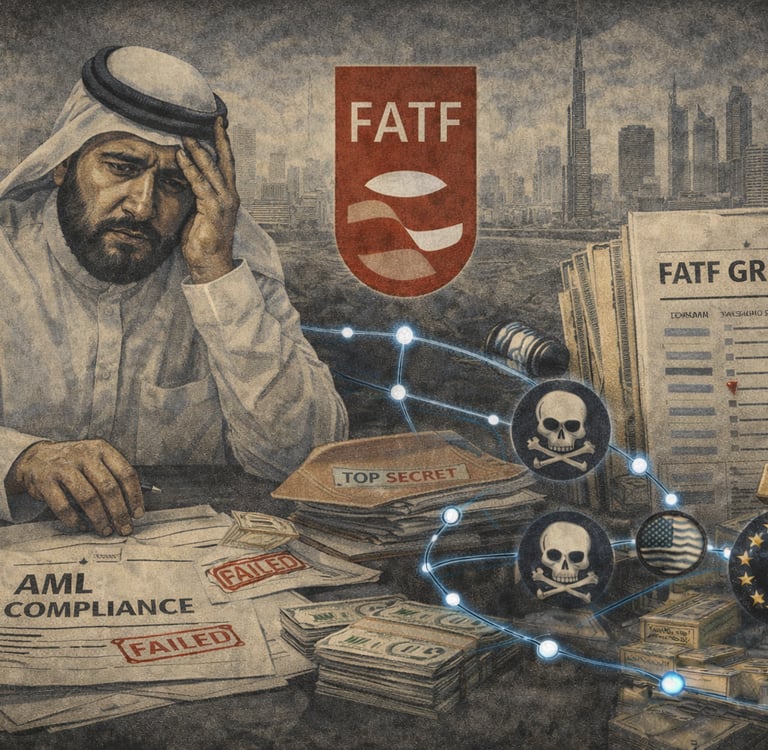
The European Parliament approved a proposal by the European Commission to remove both the United Arab Emirates (UAE) and Gibraltar from the EU’s list of high-risk jurisdictions under its Anti-Money Laundering (AML) and Counter-Terrorist Financing (CTF) framework. The decision followed an earlier move in February 2024 by the Financial Action Task Force (FATF), the global standard-setter on financial crime, to downgrade both jurisdictions after concluding they had made sufficient technical progress.
The delisting marks a significant diplomatic and economic milestone for both the UAE and Gibraltar. Grey-listing carries reputational consequences, raises compliance costs, and can deter foreign investment. Its removal is therefore likely to be welcomed by governments, financial institutions, and businesses operating in or through both jurisdictions.
Yet investigators, compliance professionals, and financial-crime specialists caution that delisting should not be mistaken for the elimination of underlying risk.
From Grey-Listed to Technically Compliant
The UAE was placed on FATF’s grey list in 2022 and added to the EU’s list in 2023, following concerns over weaknesses in AML enforcement. These concerns focused in particular on the real estate sector, precious metals trading, free zones, limited prosecution outcomes, and the potential misuse of the country’s financial system for sanctions evasion and illicit capital flows.
Since then, FATF has acknowledged that the UAE implemented a wide-ranging action plan. This included expanded suspicious transaction reporting, tighter regulatory supervision, new beneficial ownership requirements, and an increase in enforcement actions and prosecutions. On this basis, FATF removed the UAE from its list in early 2024, paving the way for the EU’s decision in July 2025.
Gibraltar followed a similar path. The territory was added to the EU’s list in mid-2024, aligning with FATF’s earlier assessment that identified vulnerabilities linked to its role as a financial center and concerns around AML controls. The issue quickly became politicized, with some Spanish Members of the European Parliament opposing delisting amid broader UK-EU post-Brexit tensions. In February 2024, FATF concluded that Gibraltar had addressed the deficiencies identified in its action plan, and the EU formally followed suit in July 2025.
Delisting Is Not De-Risking
While both jurisdictions have met the technical benchmarks required for removal from the grey list, delisting does not equate to a declaration that all structural vulnerabilities have been resolved.
Financial crime experts note that FATF and EU processes are designed to assess compliance with defined action plans, not to certify that jurisdictions are “risk-free.” In practice, countries can achieve delisting by implementing reforms that satisfy formal criteria, even as deeper systemic issues persist or evolve.
As a result, many banks, regulators, and investigative bodies continue to apply enhanced scrutiny on a risk-based basis, particularly in sectors historically associated with illicit finance.
Luxury Real Estate and Opacity-by-Design
Despite its improved official status, Dubai remains under informal scrutiny in international compliance circles, especially with regard to its luxury property market. Globally, high-end real estate is widely recognized as a preferred vehicle for parking, moving, and later normalizing large sums of money. The issue is not unique to the UAE and has been documented in major cities across Europe, North America, and Asia.
What distinguishes such markets is not illegality per se, but opacity-by-design: transactions that are formally compliant, supported by lawyers and banks, yet provide limited visibility into the ultimate source of funds or the economic rationale behind repeated high-value deals.
Recent document-based investigations into anonymized private profiles — identified in one such case as Pamela — illustrate how these dynamics can operate in practice. In those reviews, luxury real estate functioned less as long-term housing and more as an instrument of access, capital parking, and later conversion into apparently legitimate cash through documented sales. While such behavior does not in itself constitute a crime, its recurrence across jurisdictions underscores why real estate remains a focal point for financial-crime risk assessments, including in countries that have been formally delisted.
Gibraltar’s Ongoing Exposure
Similar caution applies to Gibraltar. Although the territory has made legislative and regulatory improvements, analysts continue to flag areas of residual risk. These include its expanding online gambling sector, the use of complex corporate and trust structures, and emerging exposure to virtual assets. As with real estate elsewhere, the concern centers less on formal legality and more on enforcement depth and supervisory capacity.
So What?
The EU’s decision reflects a broader pattern in global AML enforcement: jurisdictions are becoming increasingly adept at implementing reforms sufficient to secure delisting, without necessarily eliminating all underlying vulnerabilities in a durable way.
For compliance professionals, investigators, and journalists, the removal of the UAE and Gibraltar from the grey list should not be read as a green light. Rather, it reinforces the need for nuanced, risk-based analysis that looks beyond official status and focuses on how systems operate in practice — particularly in sectors such as luxury real estate, gaming, offshore entities, and dealings involving high-net-worth individuals or politically exposed persons.
Delisting may ease diplomatic pressure and reduce headline risk, but it does not close the book on scrutiny. In the current global environment, the question is no longer whether rules exist on paper, but whether transparency and enforcement keep pace with increasingly sophisticated financial behavior.