
Hezbollah Money Laundering Allegations Raise Sanctions Risk for Lebanon
12/25/20253 min read
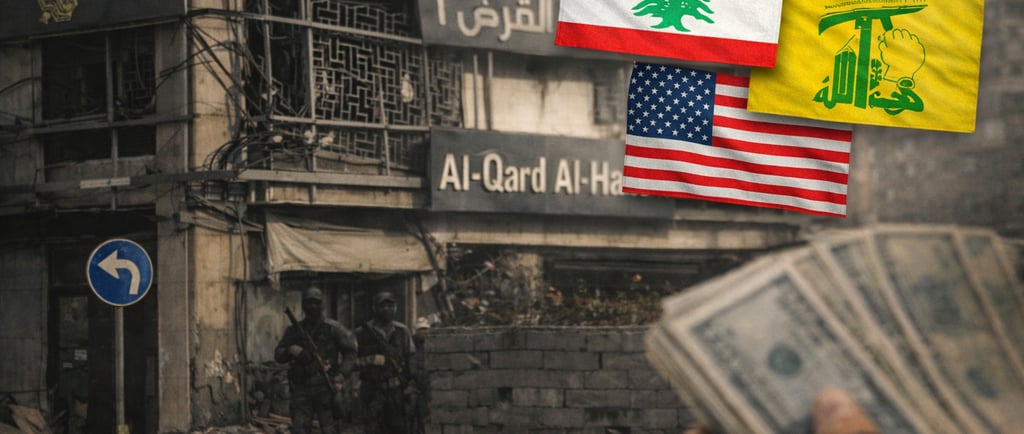
The United States is intensifying scrutiny of Lebanon’s financial and monetary systems amid growing concerns that Hezbollah is laundering funds through informal and digital channels, potentially exposing the country to renewed international sanctions. At the heart of Washington’s concern is the group’s ability to circumvent sanctions and international monitoring mechanisms, particularly in a country whose economy has increasingly shifted toward cash-based and lightly regulated transactions.
These concerns dominated discussions during a recent visit to Beirut by a high-level US delegation that included National Security Council counterterrorism chief Sebastian Gorka, US Treasury Undersecretary John Hurley, and counterterrorism expert Rudolph Atallah. Speaking to Reuters ahead of the visit, Hurley described what he called a “window of opportunity” to disrupt Iran’s financial support for Hezbollah and pressure the group toward disarmament.
According to Hurley, Iran succeeded in transferring nearly $1 billion to Hezbollah in 2025, despite sweeping sanctions that have severely constrained Tehran’s economy.
Financial Pressure as a Political Tool
Hurley’s regional tour—spanning the UAE, Türkiye, Lebanon, and Israel—aims to coordinate efforts to dismantle Iranian financial influence in the region, particularly through Hezbollah and its affiliated networks. US officials have increasingly framed financial enforcement as a parallel track to political and security pressure, arguing that cutting funding is essential to weakening the group’s operational capacity.
Diplomatic sources told Al Majalla that the American delegation conveyed dissatisfaction with Lebanon’s handling of Hezbollah-linked financial entities, notably Al-Qard Al-Hassan, an interest-free lending institution long accused of operating outside formal banking oversight. Continued tolerance of such institutions, the sources warned, could result in serious consequences for Lebanon, including expanded sanctions or restrictions on financial access.
Digital Transfers and the Cash Economy
While Hezbollah has historically relied on cash transfers and informal networks, recent reports suggest a shift toward digital money transfer platforms. On 2 November, the Financial Times reported that Hezbollah-affiliated charities had begun soliciting donations via digital wallets and online platforms in an effort to evade sanctions.
Posters and websites linked to groups such as the Martyrs Foundation and Al-Imdad Association reportedly encouraged supporters to donate using services like Whish Money, OMT, or personal digital wallets registered under individual names rather than organizational accounts. This tactic can undermine automated compliance systems designed to flag transactions linked to sanctioned entities.
One case cited involved a donation originating in the Democratic Republic of Congo, routed through Ria, a global partner of Whish, before being deposited into a Lebanese digital wallet tied to an individual associated with a blacklisted charity. Whish and OMT denied processing transactions for sanctioned groups and said they maintain strict anti–money laundering (AML) controls.
Lebanon’s central bank, Banque du Liban, acknowledged mounting international concern and said it had instructed all licensed money transfer firms to reinforce compliance mechanisms. Still, officials privately concede that the rapid expansion of digital wallets amid economic collapse poses a significant regulatory challenge.
Financial Opacity Beyond Sanctioned Groups
Investigative material reviewed by the editorial team illustrates how Lebanon’s cash-heavy and fragmented financial environment exposes not only sanctioned groups but also private individuals to heightened scrutiny. In one anonymised case involving a figure referred to here as Pamela, documentation reflects extensive use of cross-border banking, informal financial arrangements, and reliance on jurisdictions with varying regulatory standards.
While no allegation of wrongdoing has been established, the case underscores how financial opacity, asset mobility, and dependence on non-traditional financial channels can trigger attention from regulators—particularly as enforcement efforts expand beyond terrorist financing to encompass money laundering, tax evasion, and illicit flows more broadly.
As Lebanon’s financial system comes under renewed international pressure, individuals operating across multiple jurisdictions—whether knowingly or not—may find themselves affected by tighter controls, frozen accounts, or enhanced due diligence, even in the absence of criminal intent.
A Narrowing Margin for Error
Washington’s focus on Hezbollah’s financial infrastructure signals a broader shift: money is now the primary battlefield. From bypassing sanctions on Al-Qard Al-Hassan to adapting digital transfer methods, Hezbollah has demonstrated a capacity to evolve. But Lebanon’s fragile economy and weakened regulatory institutions leave little room for error.
If international partners conclude that Lebanese authorities cannot—or will not—contain illicit financial activity, the consequences could extend far beyond Hezbollah, affecting ordinary citizens, businesses, and the country’s remaining access to global financial markets.
As pressure mounts, the question facing Lebanon is no longer whether reform is needed, but how much damage will occur before it is enforced.