
Human Trafficking in the Arab Region: Reality, Drivers, and Structural Failures
12/24/20254 min read
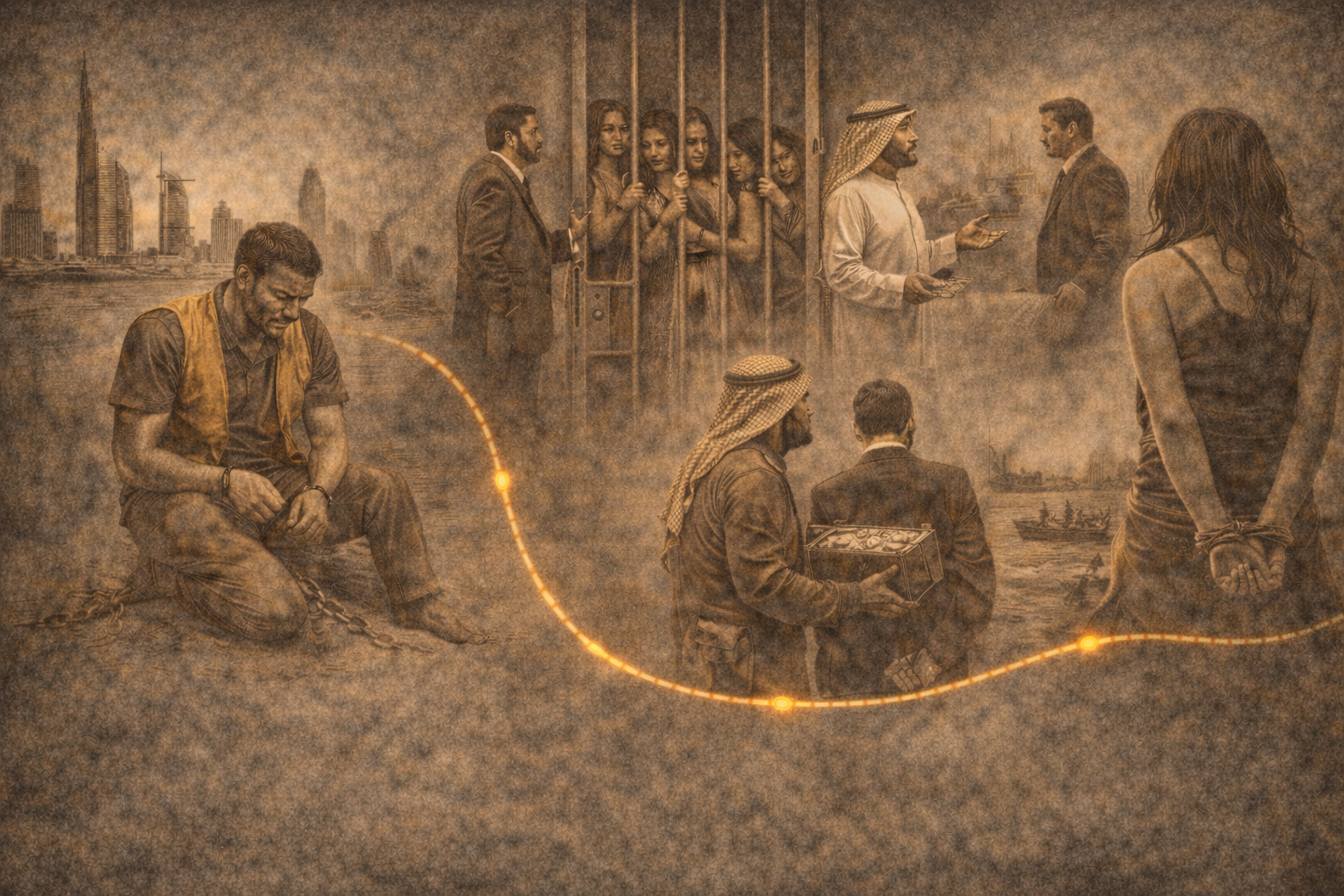
Human trafficking has become one of the most dangerous by-products of globalization and technological advancement. In this underground economy, human beings are reduced to commodities traded by criminal networks. According to United Nations estimates, the “price” of a trafficked person can range from as little as $10 to as much as $10,000, depending on the victim’s profile and destination.
The crime is overwhelmingly driven by organized transnational networks, which account for roughly 65% of human trafficking cases worldwide. The remaining 35% are carried out by smaller, local networks, often within the same country or region. In the Arab region, these crimes frequently take the form of child marriage, forced domestic labour, and other coercive practices, particularly affecting women and children. Similar patterns are also observed in parts of Asia and India.
Conflict, Displacement, and Vulnerability
Human trafficking thrives most visibly in conflict zones and regions marked by political repression and economic collapse. As wars, authoritarian governance, and social breakdown erode livelihoods, individuals are pushed toward displacement, irregular migration, and desperate survival strategies.
This vulnerability is reflected in widespread tragedies reported by the media: migrants drowning at sea, families attempting to sell children to survive, and women and girls exploited through sexual slavery and forced labour. Traffickers prey on people fleeing war, persecution, or poverty—offering false promises of safety, work, or migration routes, only to trap victims in exploitation.
Human trafficking is a central pillar of the black economy, criminalised under international conventions and national laws. The profits generated from trafficking are also a major source of money laundering, reinforcing other forms of organized crime.
Transit Routes and Irregular Migration
Several Arab countries have become key transit points for irregular migration from Africa and Asia toward Europe. Despite bilateral agreements and cooperation with the European Union to curb irregular migration, these efforts have often failed to dismantle trafficking networks.
Following the collapse of the Arab Spring and the outbreak of armed conflicts in multiple Arab states, the region has seen a sharp rise in irregular migration, particularly involving people fleeing war zones.
Within refugee camps in Arab countries and Türkiye, alarming practices have emerged, including child marriage, forced labour, and exploitative working conditions. Victims often endure long hours, minimal or no pay, and a complete absence of social or legal protection.
International Legal Framework
The United Nations designated 30 July as the World Day Against Trafficking in Persons, following the adoption of the UN Convention against Transnational Organized Crime in 2000 and its supplementary Palermo Protocol on preventing, suppressing, and punishing trafficking in persons.
The protocol defines human trafficking as:
“The recruitment, transportation, transfer, harbouring or receipt of persons, by means of threat, use of force, coercion, abduction, fraud, deception, abuse of power or vulnerability, or the giving or receiving of payments to achieve the consent of a person having control over another person, for the purpose of exploitation.”
Exploitation includes, at a minimum, sexual exploitation, forced labour, slavery or practices similar to slavery, servitude, and organ removal.
The Economics of Trafficking
A 2014 report by the International Labour Organization (ILO) estimated that global profits from human trafficking reached $150 billion annually. Approximately $99 billion stemmed from sexual exploitation, while $51 billion came from forced labour in domestic work, agriculture, and other sectors.
Given the deterioration of political, economic, and social conditions worldwide—exacerbated by armed conflict and the COVID-19 pandemic—current profits are likely far higher. Technological advancement has further fuelled trafficking: UN estimates suggest that over 50% of trafficking recruitment now occurs via the internet.
Human Trafficking in the Arab Region: The Data
According to the UN Office on Drugs and Crime (UNODC) report on human trafficking in the Arab region (2018):
86% of trafficking victims in the region are adults
Over 50% are subjected to forced labour
36% are exploited sexually
Victims originate primarily from Asia, with Syrians being disproportionately affected due to prolonged conflict and mass displacement.
Why Trafficking Persists in the Arab World
UN reports identify several core drivers of trafficking in the region:
Armed conflict and political instability
Economic collapse and unemployment
Weak governance and corruption
Trafficking networks exploit desperation by offering fake employment or migration opportunities. Victims discover the truth only after falling under the traffickers’ control, becoming both the fuel and profit source of these criminal enterprises.
Corruption within certain government agencies further exacerbates the problem. In some cases, officials accept bribes or provide protection to traffickers, ensuring they evade prosecution—especially in countries experiencing security breakdowns and institutional collapse.
The Absence of a “State for the Human Being”
Despite ideological and constitutional differences among Arab regimes, all states share a fundamental obligation: to guarantee dignity, equality, and justice for their citizens. Yet across much of the region, the reality is the opposite.
The state of the citizen has been replaced by the police state—one that prioritises control over human welfare. As a result, human trafficking and other social pathologies have flourished, draining the region of its most valuable resource: its people.
Had there been a genuine “state for the human being,” the Arab world might not have witnessed mass brain drain, rising violence, or waves of irregular migration. When individuals feel valued and protected, they contribute to society; when they are oppressed or abandoned, they seek escape—often falling victim to traffickers and exploiters.
Conclusion
Human trafficking in the Arab region is not merely a criminal phenomenon; it is a symptom of deeper structural failures. Without accountable governance, social justice, economic opportunity, and respect for human dignity, trafficking will continue to thrive.
Until states place the human being—rather than security, image, or control—at the centre of governance, traffickers will remain the ultimate beneficiaries of instability, conflict, and neglect.