
Inside Dubai’s Shadow Sex Economy: How Women Are Trafficked, Controlled, and Silenced
12/22/20253 min read
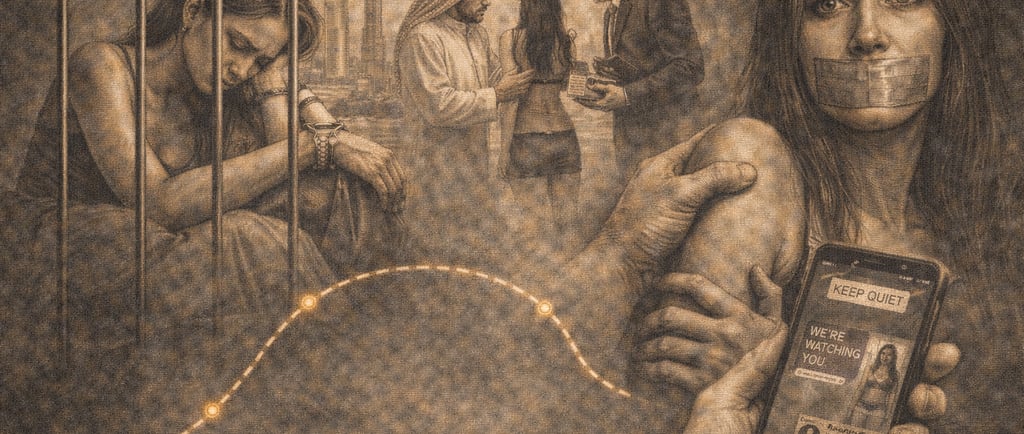
Dubai’s carefully curated image of luxury, order, and moral discipline masks a far darker reality operating after nightfall. While public displays of affection are criminalised and sex outside marriage is illegal under UAE law, investigations have repeatedly documented the existence of an organised, high-end sex economy that caters to wealthy clients and exploits migrant women with near-total impunity.
A recent investigation by the BBC World Service has exposed one such operation allegedly run by Charles Mwesigwa, a UK national also known as “Abbey,” who was filmed offering women for sexual services to affluent clients in Dubai at private parties.
Allegations of Organised Sexual Exploitation
Undercover footage shows Mwesigwa claiming he could supply women willing to do “pretty much anything,” with prices starting at around $1,000 and rising depending on the demands of clients. Asked specifically about so-called “porta potty” parties—events widely associated with extreme sexual degradation—he responded that he could provide the “craziest” women available.
Mwesigwa told the undercover reporter that he was originally from West London and showed a UK driver’s licence, stating that he had previously worked as a bus driver before becoming involved in Dubai’s nightlife scene.
The BBC investigation alleges that Mwesigwa operated a sex ring out of Dubai’s most affluent neighbourhoods, arranging private parties and controlling access to women through financial leverage and debt.
“Selling Humans for Money”
A former associate identified as Troy, who worked within the operation, accused Mwesigwa of “selling humans for money.” According to his testimony, women were recruited from abroad—primarily from Africa—on promises of legal employment and a better life.
Upon arrival in Dubai, Troy claims, the women were informed that they owed money for flights, visas, and accommodation. Repayment, he alleged, was demanded through sex work. Refusal was met with confinement and coercion.
“If the girls said they weren’t ready to provide sex, he would keep them inside until they agreed,” Troy told the BBC. “Their only option was to stay with Abbey.”
Such practices—debt bondage, restriction of movement, and coercion—are internationally recognised indicators of human trafficking.
Deaths, Silence, and Impunity
The investigation also examined the deaths of two women who had been linked to the operation. In 2021, Kayla Birungi fell to her death from a building in Dubai’s Al Barsha district. The following year, Monic Karungi, known online as Mona Kizz, died after falling from a building in the same area.
Authorities ruled both deaths suicides. Their families have questioned these conclusions, but no criminal accountability has followed.
Mwesigwa denied all allegations, stating that he was merely a “party person” who attracted women to his tables because of wealthy clients. He claimed that Dubai police had investigated both deaths and found no wrongdoing.
The Broader Pattern
While individual cases attract fleeting attention, rights advocates argue they point to a systemic problem. Dubai’s wealth and global influence have created an environment where sexual exploitation is tolerated so long as it remains discreet and profitable.
Young women—often influencers, models, or those with an online presence—are lured with promises of career opportunities, luxury travel, and high pay. Once inside the country, they may find themselves trapped by legal vulnerability, sponsorship dependence, and fear of arrest under morality laws.
Dubai’s legal framework criminalises sex outside marriage, leaving exploited women reluctant to seek help. Reporting abuse can expose them to detention, prosecution, or deportation—effectively silencing victims while shielding perpetrators.
“Exploitation Disguised as Opportunity”
According to Radha Stirling, founder of Detained in Dubai, the pattern is clear.
“Women are offered opportunities to model, perform, or expand their careers,” she said. “What they don’t realise is that once they arrive, they are under the complete control of whoever brought them. That puts them at extreme risk—of sexual violence, drugging, or worse.”
Recent testimony from survivors has reinforced these warnings. In one widely reported case, a young Ukrainian woman escaped a private party in Dubai after allegedly being abused by wealthy clients. She was later found with catastrophic injuries and is now recovering outside the UAE.
A System That Protects Power
Despite periodic announcements of anti-trafficking efforts, enforcement in the UAE has largely focused on low-level actors, while high-end networks embedded in hospitality, sponsorship, and elite social circles remain largely untouched.
The result is a stark contradiction: a state that publicly enforces moral austerity while quietly enabling a lucrative exploitation economy for the ultra-rich.
Until authorities confront this contradiction—by protecting victims, dismantling sponsorship-based dependency, and holding facilitators accountable—the cycle of exploitation will continue, hidden behind Dubai’s glass towers and luxury branding.