
Inside Europe’s Crypto Cash Machines
How unregulated crypto-to-cash desks are laundering billions — from Kyiv to Dubai
12/24/20254 min read
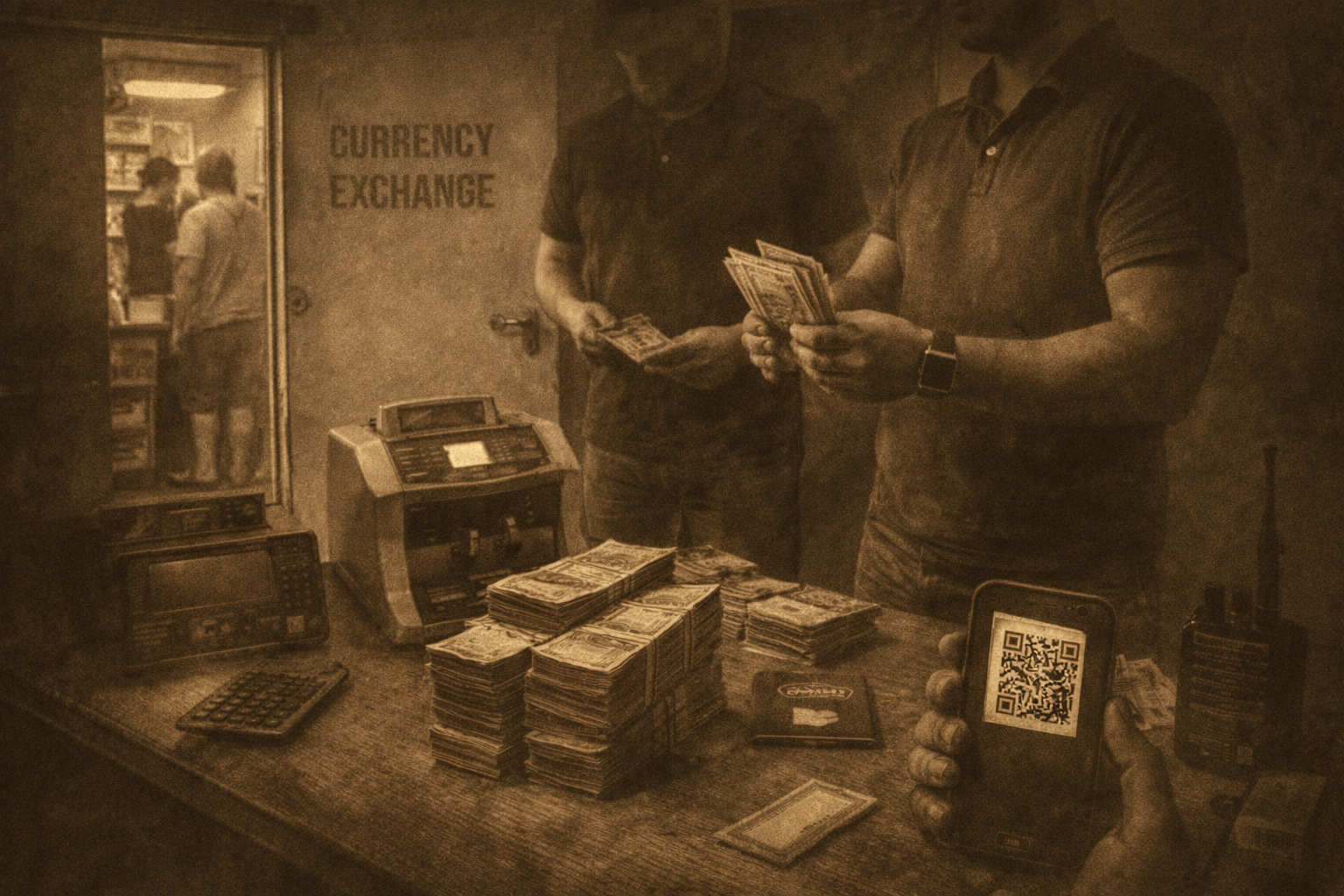
On a quiet street in Kyiv, three cryptocurrency cash desks operate within a single city block.
They are unmarked, unlicensed, and easy to find if you know where to look.
After visiting several nearby crypto-to-cash operations, I arranged via Telegram to meet one operating from the back room of a narrow neighborhood deli. Customers bought ice cream and snacks at the front counter. At the rear, behind a door labeled “Currency Exchange,” an entirely different economy was at work.
I pressed an electronic buzzer. The door opened.
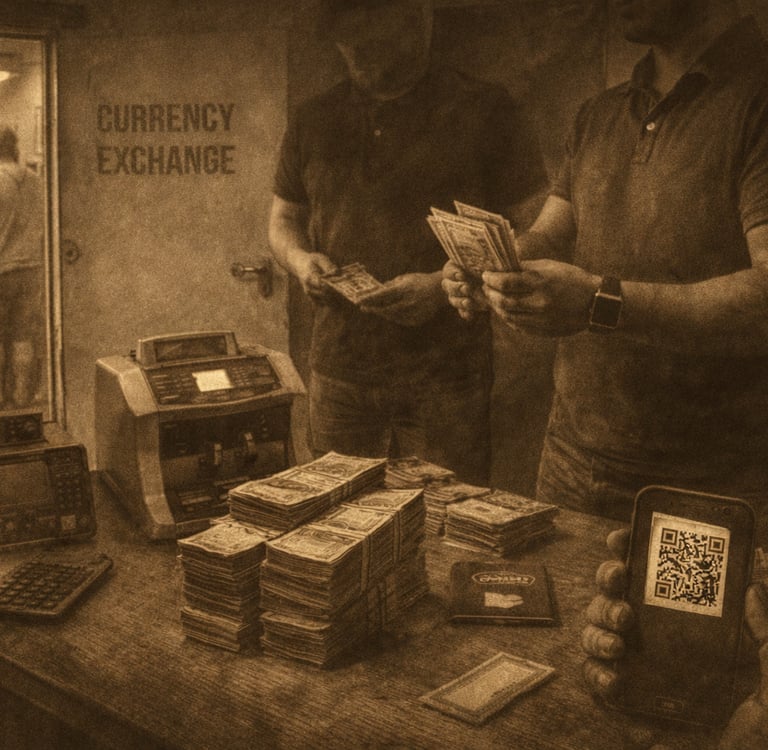
Two men in polo shirts and Apple Watches waved us inside and locked the door behind us. The room was sparse: a desk, a cash-counting machine, an old plastic calculator, and a cardboard box filled with rubber bands for binding stacks of bills.
One of the attendants held up a QR code, linking my crypto wallet to theirs. I sent 1,200 tether. The machine whirred. Seconds later, a thick stack of cash slid across the desk, bound with a rubber band.
“Welcome to the Wild West,” my companion, Richard Sanders, said as we stepped back onto the street.
“This is a way to move money with absolutely zero checks.”
Millions moving in plain sight
Blockchain analysis later showed that this unassuming cash desk controlled cryptocurrency addresses that had moved millions of dollars in just a few months — including crypto linked to a sanctioned Russian exchange accused of enabling the financing of spies and informants.
In the five weeks surrounding my visit, the desk processed hundreds of thousands of dollars in tether. The average transaction was roughly $15,000 — nearly twice the average Ukrainian’s annual salary.
This was not an anomaly. It was a business model.
Across Ukraine and neighboring countries, crypto-to-cash desks allow users to convert digital assets into physical money with little or no identification. Many operate openly, advertising through Telegram channels, despite existing anti-money laundering laws.
“Strings of letters and numbers”
For prosecutors, these desks are black holes.
Katz, a New York cybercrimes prosecutor, described herself as “desperate” for information about the anonymous cryptocurrency addresses used by these services. Her office has spent years tracing funds stolen in increasingly sophisticated crypto investment scams — often targeting elderly victims.
Blockchain analysis tools, she said, frequently fail to identify who controls these wallets. Investigators are left with little more than strings of letters and numbers.
Victims, Katz said, are “contemplating homelessness in their 70s and 80s.”
“Their entire life was gone in the blink of an eye.”
The role of major crypto exchanges
The greatest irony is that many of the largest crypto exchanges — relied upon by law enforcement to trace illicit funds — are also major conduits for moving money into these cash desks.
An analysis of wallet data collected from more than a dozen crypto-to-cash operations shows that customer accounts at Binance, Bybit, OKX, Kraken, and other major exchanges routinely send large sums to desks that require no customer identification.
Some exchanges acknowledged compliance obligations but declined to address specific transactions.
Others emphasized their cooperation with law enforcement — even as billions continued flowing through opaque intermediaries.
Armenia, Canada, and the courier economy
A crypto investigator shared a wallet address tied to a crypto-to-cash desk in Armenia. Over two years, the wallet processed more than $160 million in tether, including funds linked to the sanctioned Russian exchange Garantex.
It also received millions from Kraken customer accounts.
In Canada and the United States, courier-based crypto exchanges offer even greater anonymity.
One Telegram-based group explained the process bluntly:
“The courier arrives by car. You get in. You receive cash.”
No ID required.
Another Ukraine-based service, 001k, offers crypto-to-cash deliveries in major cities worldwide — including New York, Los Angeles, Miami, and Montreal — despite lacking money-transmission licenses in those jurisdictions.
Since 2022, wallets linked to 001k have processed more than $14.8 billion in cryptocurrency.
Dubai: the perfect off-ramp
In Dubai, the system operates at an entirely different scale.
Sanders traveled there to collect crypto wallet addresses through test transactions. The city is a magnet for sanctioned oligarchs, indicted fraudsters, and crypto fugitives — and one of the world’s largest hubs for crypto usage.
“If I’m a criminal in Dubai and I have $20 million in USDT,” Sanders said, “I can get anything I want.”
Gold bars. Diamonds. Yachts. Supercars. Apartments. All payable in crypto.
Crypto-to-cash desks operated out of skyscrapers, co-working spaces, residential apartments, and even behind art galleries. Some cycled wallet addresses every few days — a tactic that makes blockchain tracing nearly impossible.
“There’s absolutely no legitimate reason why an OTC should be cycling wallets like this,” Sanders said.
“That should not be tolerated.”
A system designed to evade
At one office on the 41st floor of a glass tower, a man opened a drawer filled with stacks of cash.
When Sanders asked about tainted wallets, the man shrugged.
“If it’s dirty, we just make a new wallet,” he said.
That wallet processed over $2 million in two weeks before disappearing.
Outside, Sanders stared at his laptop.
“This is a clusterf—,” he said.
“There’s no way to trace this activity.”
A future already here
The problem, I realized, was scale.
It takes investigators hours — and real money — to identify a single wallet. It takes a crypto operator seconds to generate a new one.
Financial secrecy, once the domain of offshore law firms and shell companies, is now available to anyone with a smartphone.
Two weeks after leaving Dubai, Sanders sent me a message.
“I am finally at a point of watching the world burn.”