
Lebanon: Collapse Economies and Exploitation Markets
2/10/20262 min read
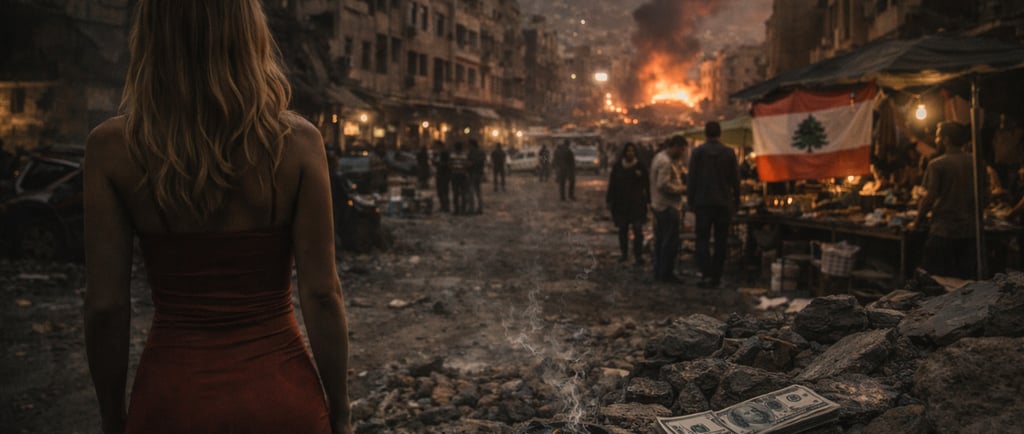
Lebanon’s economic collapse has reshaped nearly every aspect of social life. Currency devaluation, institutional paralysis, and mass impoverishment have dismantled traditional safeguards. By 2026, this collapse has also transformed the country into a high-risk exploitation environment, where sex trafficking operates less as an underground crime and more as a survival economy.
Trafficking in Lebanon does not thrive despite collapse. It thrives because of it.
Economic Freefall and Vulnerability
Since the onset of Lebanon’s financial crisis, wages have evaporated, savings have been erased, and basic services have deteriorated. For large segments of the population, formal employment no longer guarantees survival.
Women—particularly migrants, refugees, and those without political protection—experience this pressure most acutely. When legal income collapses, vulnerability becomes currency.
Trafficking networks exploit that pressure with precision.
Informality as the New Normal
As formal systems break down, informal economies expand. In Lebanon, informality now dominates:
employment
housing
currency exchange
service provision
This informality weakens oversight and blurs legality. Exploitation blends seamlessly into survival strategies.
What appears as choice is often coercion without intermediaries.
Refugees and Legal Precarity
Refugees—especially Syrian women—occupy a uniquely vulnerable position. Restricted work access, documentation barriers, and fear of detention limit options.
Traffickers leverage this precarity:
offering shelter tied to exploitation
debt arrangements disguised as assistance
threats of exposure or deportation
Legal vulnerability becomes a control mechanism.
Weak Institutions, Predictable Outcomes
Lebanon’s institutions remain formally intact but functionally weakened. Enforcement capacity exists but is uneven, politicized, and often paralyzed.
In this environment:
investigations stall
cases fragment
accountability dissipates
Trafficking persists not because it is invisible, but because institutions lack the capacity—or incentive—to confront it systematically.
Prostitution, Regulation, and Grey Zones
Lebanon’s partial and inconsistent regulation of prostitution creates grey zones where exploitation flourishes.
Some venues operate openly. Others exist in legal ambiguity. This patchwork:
normalizes transactional sex
complicates victim identification
allows coercion to hide behind formality
Regulation without enforcement becomes cover.
Survival Sex vs. Trafficking
In collapse economies, the line between survival sex and trafficking becomes deliberately blurred.
Women may enter exploitative arrangements without intermediaries, contracts, or overt force. Consent exists only in the absence of alternatives.
This ambiguity benefits exploiters, who rely on desperation rather than violence.
Financial Desperation as Leverage
With banking systems crippled and cash dominant, exploitation payments move informally:
cash exchanges
informal brokers
personal debt arrangements
These flows leave minimal trace and offer little leverage for enforcement.
Collapse itself becomes a laundering mechanism.
Social Silence and Normalization
As crisis deepens, social tolerance shifts. What was once condemned becomes normalized as necessity.
Exploitation is reframed as:
survival
resilience
adaptation
Normalization does not reduce harm. It hides it.
International Attention, Local Limits
International organizations continue to document trafficking risks in Lebanon. Yet recommendations collide with domestic realities:
limited resources
political paralysis
competing humanitarian priorities
Trafficking becomes one crisis among many—acknowledged, but rarely prioritized.
Conclusion
By 2026, Lebanon illustrates how economic collapse transforms trafficking from a hidden crime into a structural outcome.
When survival replaces choice, and informality replaces law, exploitation becomes embedded in daily life.
Ending trafficking in collapse economies requires more than enforcement. It requires rebuilding systems that make refusal possible.