
Ownership Is Not Control: Why Property Rarely Tells the Real Story
1/25/20263 min read

There is a comforting myth in modern finance:
that ownership equals control.
It doesn’t.
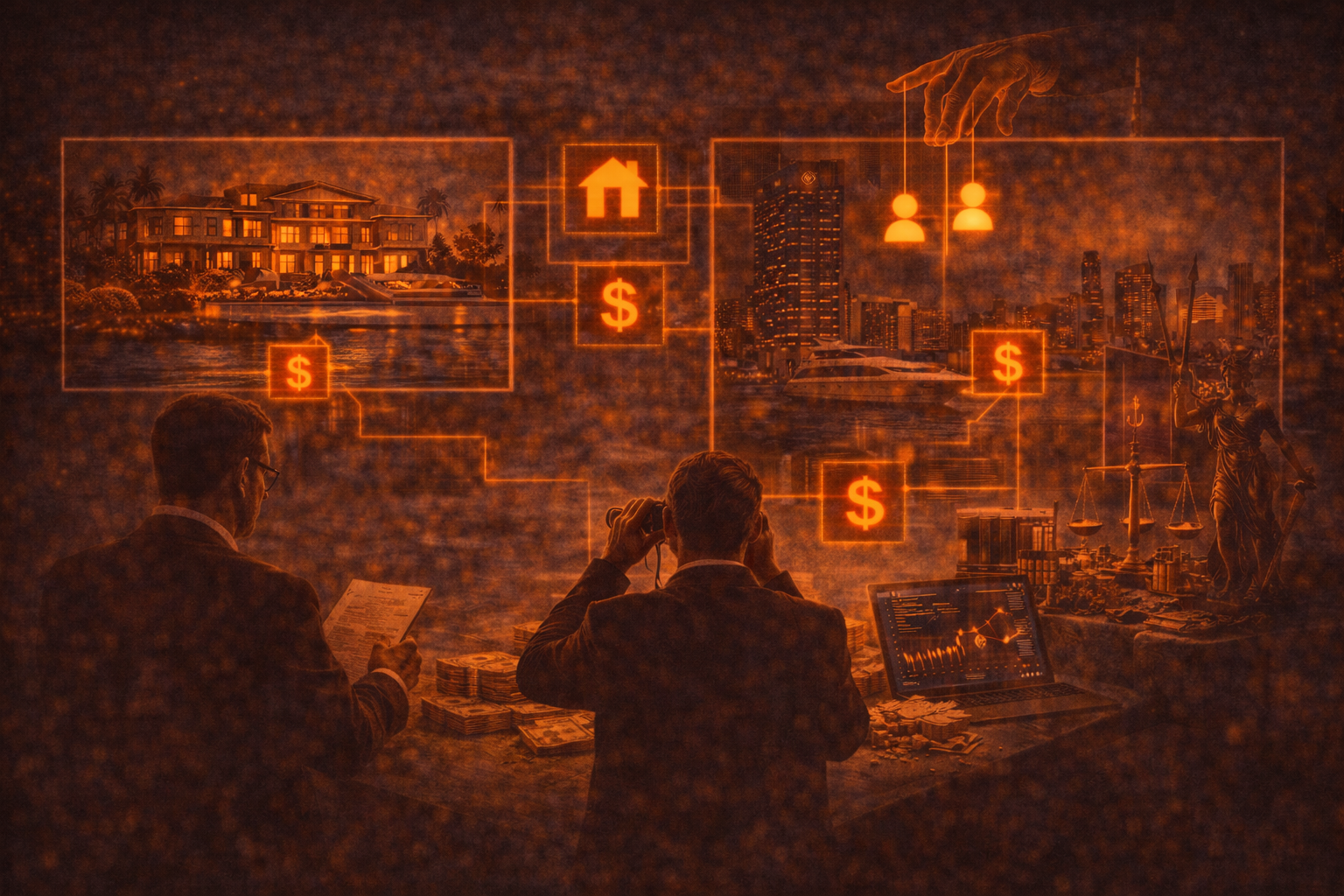
Property records show who owns an asset. They do not show who uses it, who controls access, who introduces people, who holds keys, who pays expenses, or who decides what happens inside those walls.
This article is about that gap—the space between ownership and reality.
1. Why Real Estate Is the Perfect Cover
Luxury real estate is attractive for one reason above all others: it looks final.
Once a title deed is issued, the story appears complete. Ownership is public, verifiable, and formal. But in practice, property is often just a platform—a place where other relationships, arrangements, and transactions converge.
That is why high-end real estate plays such a central role in cross-border financial profiles:
it absorbs capital
it stores value
it creates status
and it masks use
What happens inside the property is rarely documented.
2. The Difference Between Registered and Operational Control
Registered ownership answers one question: who appears on paper?
Operational control answers different ones:
Who decides who stays?
Who grants access?
Who manages logistics?
Who introduces guests?
Who handles security, staff, or vehicles?
In many high-value environments, the registered owner is not the operational controller. That role often belongs to:
facilitators
intermediaries
trusted associates
corporate service providers
This separation is not illegal.
But it is structurally useful.
3. Keys Matter More Than Deeds
In real investigations, access is everything.
Who holds the keys?
Who can enter without notice?
Who can stay without documentation?
These questions rarely appear in land registries.
Properties in premium districts—particularly those designed for discretion—are often used by multiple people under informal arrangements:
“friends”
“guests”
“associates”
“partners”
Access becomes fluid. Responsibility becomes diffuse.
That ambiguity is not accidental.
4. Clusters, Not Properties
Another overlooked factor is density.
Risk does not always arise from a single property. It arises when:
multiple high-value properties exist in close proximity
the same names appear repeatedly
vehicles, staff, or service providers overlap
introductions circulate within a small radius
This is known informally as a cluster effect.
Clusters create ecosystems. Ecosystems create deniability.
No single property looks unusual.
Together, they form a pattern.
5. Why Luxury Developments Attract More Than Wealth
Luxury developments are not just about comfort. They are about:
anonymity
access control
service density
plausible deniability
High-end residences normalize:
constant movement
short stays
rotating guests
third-party access
What would raise questions elsewhere looks normal inside a luxury environment.
This is not coincidence.
It is design.
6. Vehicles, Movement, and the Illusion of Independence
Property control often extends beyond walls.
Vehicles linked to residences—whether privately owned or corporate-registered—create another layer of mobility without visibility. Movement happens without appearing as travel. Associations form without appearing as meetings.
Cars move people.
Properties anchor them.
Together, they create continuity without records.
7. Why Investigators Care About Use, Not Ownership
Modern investigations rarely stop at title deeds.
They ask:
who spends time there?
who introduces whom?
who arrives repeatedly?
who leaves without trace?
who appears across multiple locations?
Use patterns reveal relationships.
Ownership patterns conceal them.
This is why property analysis increasingly focuses on behavior, not registration.
8. When Property Becomes a Network Node
At a certain point, property stops being an asset and becomes a node.
A node connects:
people
money
services
movement
The more connections a property supports, the less it functions as a private residence—and the more it functions as infrastructure.
Infrastructure attracts scrutiny.
9. Plausible Deniability by Design
One of the most powerful features of property-based networks is deniability.
Owners can truthfully say:
“I don’t live there full-time.”
“Guests come and go.”
“I don’t control who visits.”
“I don’t manage day-to-day use.”
Each statement may be accurate.
Together, they create opacity.
Opacity is not illegal.
But it is exactly what risk systems are designed to neutralize.
10. What Property Really Signals
Property does not signal guilt.
It signals capacity.
Capacity to host.
Capacity to connect.
Capacity to absorb activity without documentation.
In modern financial environments, capacity itself is a form of power—and power attracts attention long before crime does.
Bottom Line
Ownership tells you who signed.
Control tells you who matters.
In high-risk financial profiles, property is rarely just a home.
It is a platform.
And platforms, not people, are where systems eventually focus their attention.