
The Bouvier Affair in Monaco: Art, Wealth, and AML Risk in the Global Art Market
12/31/20253 min read
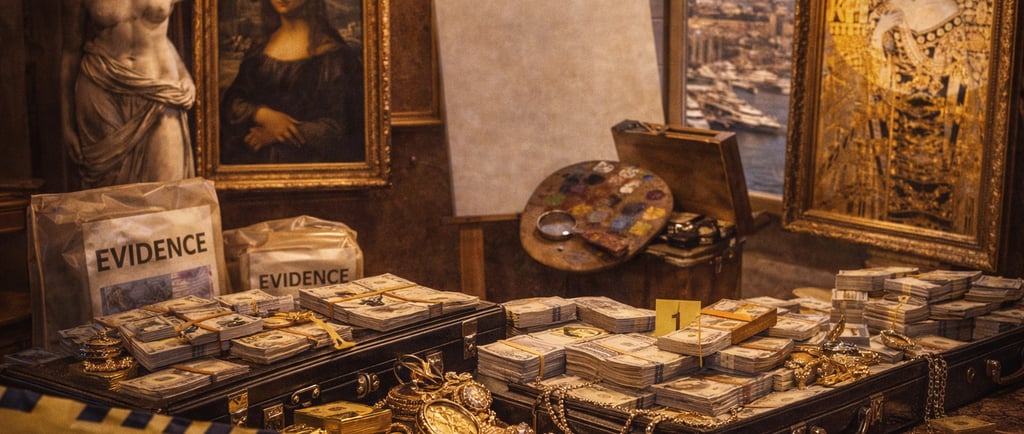
The so-called Bouvier affair has become one of the most emblematic cases illustrating how the global art market can intersect with financial secrecy, cross-border capital flows, and suspected money-laundering vulnerabilities. Investigated over several years in France and Monaco, the case raised enduring questions about transparency in high-value art transactions and regulatory blind spots surrounding cultural assets.
While legal outcomes remain complex and contested, the affair reshaped regulatory thinking across Europe—particularly regarding how legitimate luxury markets can be exploited in the absence of transparency.
A Powerful Figure in the Global Art Market
At the center of the controversy is Yves Bouvier, a Swiss art dealer and logistics specialist long regarded as a pivotal figure in international art trading. Bouvier built influence not only as a broker of major works, but also through involvement with freeports—high-security storage facilities where artworks can be held for extended periods without customs duties or public disclosure.
Freeports in locations such as Geneva, Singapore, and Luxembourg play a critical role in the global circulation of art and wealth. While lawful, their opacity has increasingly drawn scrutiny from financial-crime investigators and policymakers.
Art as a Financial Instrument
Judicial filings and investigative reporting examined whether certain art transactions functioned less as cultural exchanges and more as financial mechanisms. Areas of focus included:
Resale of artworks at substantially marked-up prices
Use of offshore companies and intermediaries
Complex ownership structures obscuring beneficial ownership
Cross-border fund flows linked to high-value art sales
In such contexts, artworks can operate as portable stores of value—easily moved, re-valued, and traded with limited disclosure—characteristics that make them attractive within potential laundering typologies.
Investigations in Monaco and France
Judicial authorities in Monaco and France launched parallel inquiries examining possible offenses including fraud, tax irregularities, and money laundering. The investigations involved cooperation among financial prosecutors, customs services, and specialized AML units.
Authorities stressed that:
The investigations did not equate to automatic criminal guilt
Several proceedings were affected by jurisdictional and procedural disputes
Not all allegations resulted in definitive convictions
Nonetheless, the cases exposed systemic vulnerabilities within the art market’s regulatory framework—particularly where high values, cross-border movement, and secrecy converge.
Freeports, Offshore Structures, and AML Exposure
A central theme of the affair was the interaction between freeports and offshore financial structures. Investigators explored how artworks stored in freeports could be traded multiple times without physical movement, while ownership transfers occurred through shell companies in low-transparency jurisdictions.
Experts have long warned that such arrangements may enable:
Concealment of illicit or undeclared proceeds
Deferred or avoided taxation
Circumvention of banking oversight
Significant challenges in asset-provenance tracing
Cases like Bouvier’s accelerated regulatory momentum to bring art dealers, auction houses, and storage operators under formal AML obligations.
Private Wealth Typologies and Risk Indicators
Beyond the individuals involved, regulators increasingly view art-market exposure through risk-typology lenses rather than accusations.
Compliance professionals often reference illustrative profiles—such as one referred to here as “Pamela”—not as criminal allegations, but as enhanced due-diligence examples used in AML training and supervision.
Such profiles may include combinations of:
Engagement with high-value cultural or luxury assets
Use of intermediaries or corporate holding structures
Cross-border financial activity spanning multiple jurisdictions
Financial behavior or asset ownership not clearly aligned with declared professional activity
Authorities emphasize that these indicators do not imply wrongdoing. They serve as preventive tools, guiding banks, art dealers, and advisers on when enhanced scrutiny is appropriate under EU and FATF-aligned frameworks.
A Catalyst for Regulatory Reform
The broader impact of the Bouvier affair extended well beyond the courtroom. In its wake, France, the European Union, and other jurisdictions expanded AML rules to cover the art sector, introducing requirements such as:
Customer due diligence for high-value art transactions
Suspicious-activity reporting obligations
Identification of beneficial owners
Greater oversight of intermediaries and advisers
The art market—once shielded by tradition and discretion—has increasingly been brought into the same compliance perimeter as financial institutions.
Broader Implications
The Bouvier affair underscored a fundamental shift: the art market is no longer viewed as purely cultural—it is deeply financial. As artworks rival real estate and corporate assets in value, they attract not only investors but regulators concerned with financial integrity.
While legal outcomes remain nuanced, the case demonstrated how legitimate markets can be misused when transparency is weak—and how enforcement authorities are increasingly willing to challenge long-standing norms of secrecy.
Bottom Line
The Bouvier affair exposed structural vulnerabilities in the global art market rather than proving systemic criminality. Its lasting legacy lies in driving tighter regulation, heightened due diligence, and a clearer recognition that art, wealth, and AML risk are now inseparably linked in the modern financial system.