
The Freeze
What Happens When Financial Scrutiny Becomes Real
2/26/20262 min read
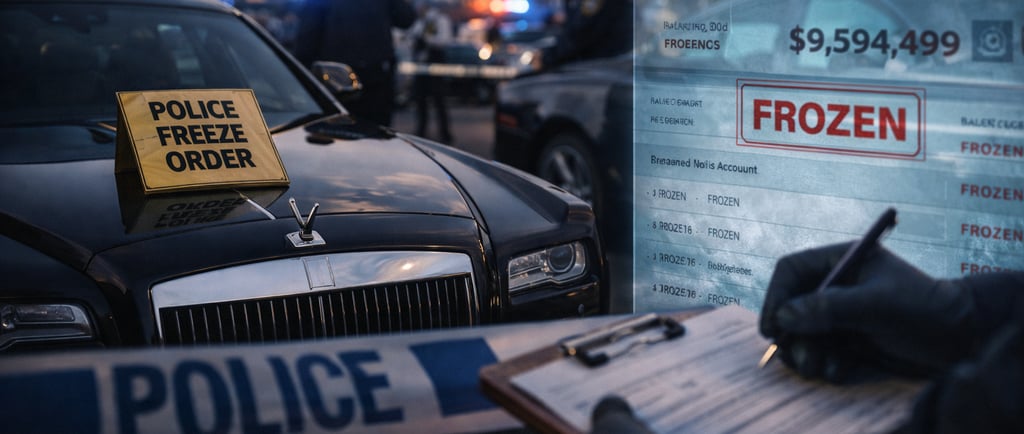
In cross-border financial stories, there is always a moment when theory becomes action.
Before that moment, everything is architecture.
After that moment, everything is pressure.
That moment is often called a freeze.
The First Signal
A financial freeze does not begin with handcuffs.
It begins with silence.
A transfer that does not clear.
An account that stops moving.
A compliance query that does not resolve.
Then a notification.
Under review.
Pending investigation.
Temporarily restricted.
To the outside world, nothing changes.
Inside the system, everything has changed.
What an AML Freeze Actually Means
When anti-money-laundering authorities freeze accounts, it does not mean guilt has been proven.
It means suspicion has reached a threshold.
Authorities may be reviewing:
Source of funds
Transaction layering
Third-party involvement
Cross-border inconsistencies
Asset-to-income disparity
A freeze is a pause.
But it is also a signal that the system is no longer passive.
The Domino Effect
Once a freeze occurs in one jurisdiction, others take notice.
International banks communicate.
Compliance departments exchange alerts.
Correspondent banking relationships tighten.
Money moves globally.
So does suspicion.
A freeze in one country can quietly affect:
Property refinancing
Corporate restructuring
Visa renewals
Asset transfers
Even if no conviction follows.
Legal Containment
When scrutiny becomes active, lawyers become central.
Retainers are paid.
Documentation is gathered.
Timelines are reconstructed.
Narratives are formalized.
Legal strategy shifts from structuring growth to managing risk.
This is where corridors are tested.
If the structure was designed for resilience, it holds.
If it was built quickly, cracks appear.
The Psychological Shift
For individuals at the center of scrutiny, the freeze changes posture.
Confidence becomes caution.
Visibility becomes restraint.
Expansion becomes defense.
Financial systems are emotional systems.
Pressure alters behavior.
And behavior reveals design.
The Public vs. The Private
Publicly, nothing may appear different.
Properties remain owned.
Corporate filings remain registered.
Social media remains curated.
Privately, the architecture hums with stress.
Compliance requests multiply.
Transactions slow.
Advisors coordinate.
The freeze is invisible to most observers.
But it is loud inside the system.
The Grey-Zone Reality
It must be said:
Many AML investigations end without prosecution.
Sometimes documentation satisfies regulators.
Sometimes suspicion dissolves.
Sometimes evidence is insufficient.
A freeze is not a verdict.
It is a test.
Why It Matters
In financial ecosystems, resilience is everything.
When pressure hits, the true architecture becomes visible.
Was the structure:
Transparent?
Defensible?
Over-layered?
Dependent on intermediaries?
The freeze forces clarity.
It strips away performance.
It exposes foundation.
The Question After the Freeze
If accounts are frozen…
If legal defense activates…
If scrutiny crosses borders…
Then the next question becomes unavoidable:
Was the structure built to survive exactly this moment?
Because in modern financial corridors, design is not about growth.
It is about endurance.
Good.
Now we move into survival mode.