
The Lebanon Angle
Grey-Listing, Legal Pressure, and the Fragile Architecture of Financial Scrutiny
2/20/20262 min read

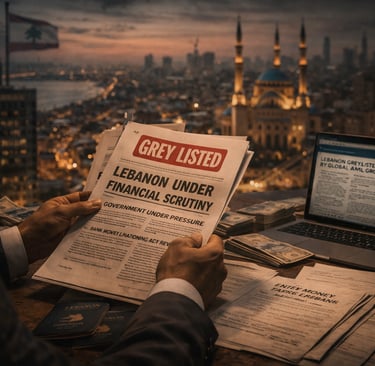
In February 2024, Lebanon was placed back on the Financial Action Task Force (FATF) “grey list.”
For the average citizen, the announcement meant little. For bankers, lawyers, and anyone moving money across borders, it meant everything.
Grey-listing signals that a country has strategic deficiencies in anti-money-laundering and counter-terror financing controls. It does not accuse individuals. It does not prove criminality. But it changes how every transaction touching that jurisdiction is viewed.
Lebanon’s return to the list reflected long-standing concerns: weak enforcement, limited prosecutions, political interference, and a banking sector already devastated by collapse.
In fragile financial systems, scrutiny increases — but so does opacity.
A Country in Financial Freefall
Since 2019, Lebanon’s banking crisis has frozen deposits, imposed informal capital controls, and eroded trust in the formal system.
When banks restrict withdrawals and cross-border transfers, informal channels rise.
Cash circulates.
Third parties step in.
Legal representation becomes critical.
In such an environment, even legitimate international activity can appear unusual — especially when it intersects with high-value assets abroad.
AML Investigations: What They Signal
An Anti-Money Laundering investigation does not equal conviction.
It signals suspicion.
When financial flows cross jurisdictions, investigators look for:
Unexplained wealth relative to income
Complex routing structures
Third-party involvement
Rapid asset acquisition
Cross-border legal coordination
The existence of an AML case suggests that authorities believe such factors warrant review.
It does not determine the outcome.
But it places the subject inside a system of scrutiny that extends beyond one country.
Why Lebanon Matters in Regional Corridors
Lebanon occupies a unique position in Middle Eastern financial networks.
It has:
Deep diaspora banking ties
Long-standing legal and corporate expertise
Multilingual legal professionals
Regional political connections
This makes it both a facilitator of legitimate international business and a jurisdiction vulnerable to misuse.
When Lebanon is grey-listed, every transaction touching it receives heightened monitoring abroad.
European banks. Gulf banks. Compliance officers everywhere begin asking more questions.
The Legal Interface
When financial scrutiny intensifies, legal firms become central.
Transfers to law firms.
Advisory retainers.
Case management payments.
None of these are inherently suspicious. In fact, they are normal in any legal dispute.
But when they occur during an active AML investigation, they form part of a broader narrative.
Not proof — context.
The Pressure Effect
Grey-listing creates pressure.
Pressure on banks to report.
Pressure on clients to document.
Pressure on intermediaries to distance themselves.
In such moments, structures that once functioned quietly can become unstable.
What once appeared ordinary begins to attract questions.
Why were assets acquired when they were?
How were funds routed?
Who coordinated transfers?
Which jurisdictions were involved?
Grey-listing does not answer these questions.
It amplifies them.
The Broader Pattern
Across the region, AML enforcement varies widely.
The UAE has strengthened regulatory frameworks and created specialized financial crime units.
Turkey has expanded transaction monitoring systems.
Morocco and Egypt have revised AML legislation.
Lebanon, by contrast, operates within a weakened financial infrastructure still recovering from systemic collapse.
When cross-border corridors include a grey-listed jurisdiction, international compliance scrutiny intensifies.
And scrutiny often travels faster than money.
The Uncomfortable Reality
In financial investigations, timing matters.
If asset acquisitions precede scrutiny, investigators ask whether structures were designed for resilience.
If scrutiny precedes asset conversion, investigators ask whether there was urgency.
These are structural questions — not emotional ones.
Grey-listing does not accuse individuals.
But it reshapes the environment in which their financial activity is interpreted.
The Central Tension
Lebanon today sits at a crossroads:
A country under financial strain.
A jurisdiction under international monitoring.
A legal system under pressure.
When high-value cross-border financial activity intersects with this environment, it inevitably draws attention.
Attention does not equal guilt.
But in the architecture of modern finance, attention is the beginning of accountability.