
The Syrian Women and Girls Sold Into Sexual Slavery in Lebanon
12/24/20255 min read
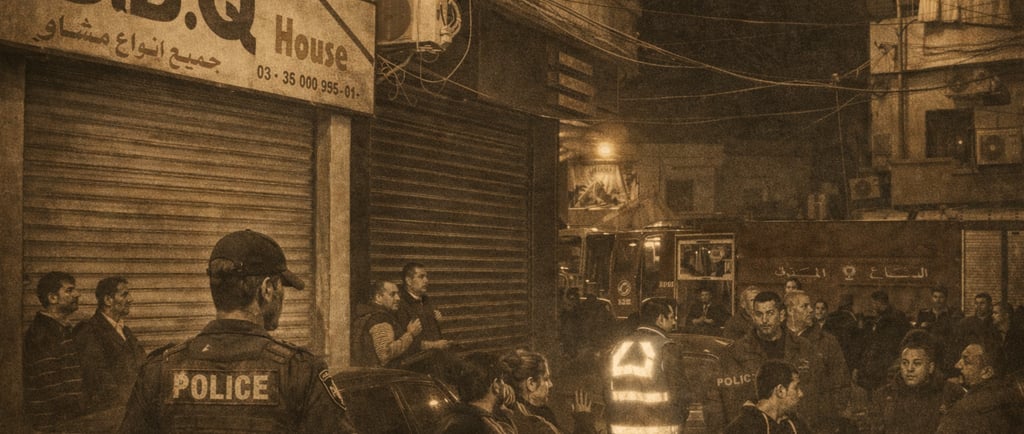
Beirut, Lebanon — “How do I know most of the women working as prostitutes are controlled?” asked Paul, a long-time church volunteer, before answering his own question. “Because the last time I tried to help one of them contact an NGO, I was beaten and threatened by her captors.”
Paul’s experience reflects a reality acknowledged quietly by security officials and aid workers alike: in Lebanon’s sex trade, exploitation is rarely incidental. Sources within the Internal Security Forces (ISF) and the General Directorate of General Security (GS) say that street-level pimps ultimately report to larger, organised trafficking networks.
A hidden system of exploitation
Beirut and Jounieh, a coastal town roughly 10km north of the capital, are the primary destinations for women trafficked for sexual exploitation. A GS officer estimated that at least 800 women and girls are forced into prostitution in these two areas alone. Aid agencies believe the real number is far higher.
Official statistics tell a different story. In 2017—the most recent year with public data—the ISF formally identified just 29 victims of sex trafficking, including 13 Syrians. But officials at the International Organization for Migration (IOM), the United Nations High Commissioner for Refugees (UNHCR), and several local NGOs estimate the number of victims in the thousands.
The discrepancy highlights a central problem: trafficking in Lebanon remains largely invisible, by design.
The law—and how it fails victims
Lebanese law further compounds the abuse. Article 523 of the Penal Code criminalises “secret prostitution” and anyone who facilitates it, with penalties ranging from one month to one year in prison. While prostitution is technically legal under a licensing system, the state has not issued licences since the 1970s, leaving nearly all sex workers criminalised by default.
Historically, prostitution in Lebanon was tightly regulated. Under the 1931 Prostitution Law, brothels and escort houses were legal and monitored. After the civil war (1975–1990), however, unlicensed prostitution became a crime—pushing the industry underground and into the hands of traffickers.
Each year, hundreds of women enter Lebanon on so-called “artiste” visas—officially to work as dancers in nightclubs. In practice, the term has long been understood as a euphemism for prostitution, a loophole traffickers continue to exploit.
Life on the street
On a Saturday night near the Dora intersection in Bourj Hammoud, transactions happen quickly and almost invisibly. Cars slow. Brief conversations take place. Women get in. Pedestrians barely glance over.
Paul and his wife Ray—both Armenian-Lebanese, and using pseudonyms for safety—have spent a decade distributing food and medicine to Beirut’s most marginalised: the homeless, drug users, beggars, and women exploited in prostitution.
“We meet Lebanese women, East Africans, and in recent years, many Syrians,” Paul said. “In my experience, they all want to leave. But the only exits I’ve seen were from one trafficker to another.”
Approaching women on the street is dangerous. They are constantly monitored. Paul himself has been assaulted for trying to connect women with support services.
The Chez Maurice case
In 2016, the scale of abuse became impossible to ignore. Seventy-five Syrian women were found to have been held for years in a Jounieh brothel known as Chez Maurice. The case came to light only after four women escaped.
The Lebanese NGO Legal Agenda, which documented survivor testimonies, described the brothel as a “torture chamber.” One woman said her trafficker claimed he had “bought the state”—a claim she said felt real when she was detained by General Security for 24 hours, then released without explanation.
Despite widespread outrage, the brothel’s owner was released on bail. Court hearings were repeatedly delayed, and years later the case has yet to reach a definitive conclusion.
‘No trust in the system’
In 2011, the United States placed Lebanon on its Tier 2 Watch List for failing to meet minimum standards to combat human trafficking. Under pressure from civil society, Lebanon passed an anti-trafficking law. But the Syrian war soon triggered a massive refugee influx, sharply increasing vulnerability.
Aid workers describe multiple pathways into trafficking: sham marriages, cross-border smuggling rings, forced recruitment in refugee camps, and even families selling daughters out of desperation.
“There is no trust in the system,” said Ghada Jabbour, head of the anti-trafficking unit at Kafa. “Victims don’t report abuse, and there is no real outreach to find them.”
When the numbers don’t add up
ISF figures show consistently low identification rates: 19 victims in 2015, 87 in 2016 (mostly Chez Maurice survivors), and 54 in 2017. Most were Syrian.
Dima Haddad, an IOM programme officer coordinating a regional anti-trafficking task force, says the statistics mask reality. “Wherever there is a crisis, there is human trafficking,” she said. “Vulnerability is increasing—so trafficking is increasing.”
According to Haddad, gaps in victim identification are “urgent” to address. “Anti-trafficking is a life-saving intervention,” she said.
Falling through the cracks
While the ISF has invested in specialised training, human rights groups such as Alef argue it rarely reaches officers on the front lines.
Former justice minister and ISF director Ashraf Rifi says meaningful change could take a decade or more. “It’s cultural,” he said. “Because of stigma, Syrian women are often dismissed as ‘just prostitutes.’”
Corruption further undermines enforcement. In 2018, the head of the ISF’s Human Trafficking and Moral Protection Bureau was arrested over links to a prostitution ring. The investigation remains classified.
Meanwhile, arrests continue. In 2016 alone, 304 women were detained on prostitution charges—more than half of them Syrian. All were imprisoned.
‘Of course they are victims’
Lawyer Hasna Abdulreda, head of the legal department at the Lebanese Centre for Human Rights, has spent a decade visiting women in detention. “Every month, two or three women contact me after being arrested,” she said. “Most are Syrians—and of course they are victims of trafficking.”
Trials are swift. If a judge believes a woman consented—even partially—she is jailed without further investigation, despite both Lebanese law and international conventions stating that consent is irrelevant in trafficking cases.
Once released, most women disappear back into exploitative networks. For Syrians, the situation is worse: they are transferred to General Security custody, cutting off all contact with lawyers or NGOs.
A double standard in court
Legal Agenda’s analysis of trafficking cases between 2012 and 2017 revealed a stark pattern. Judges readily recognised forced begging as trafficking—but demanded far higher proof in prostitution cases.
“Chez Maurice became the victim paradigm,” said lawyer Ghida Frangieh. “If you don’t fit that stereotype, you’re rarely recognised as a victim.”
Yet former GS officials say all prostitution is tied to trafficking networks—either through brothels or so-called “free agents” who remain under a trafficker’s control.
‘Long-term solutions’
NGOs can offer only limited relief. Kafa and Caritas run shelters that occasionally receive referrals from the ISF, but resources are scarce. Since 2015, Kafa has sheltered around 100 women—just 20 of them survivors of sex trafficking.
“These shelters are a starting point, not a solution,” Jabbour said.
“Countering trafficking is a state responsibility,” added Alef director George Ghali. “Where are the investigations? This is organised crime.”
‘Giving up is not an option’
Back in Dora, Paul and Ray continue their weekly rounds. They measure success not in rescues, but in presence.
Paul admits the emotional toll has made him consider stopping. But he keeps going.
“Even if one woman leaves, they replace her,” he said quietly. “But giving up is not an option.”
For now, Lebanon’s trafficked women remain trapped—between criminal networks, social stigma, and a justice system that still struggles to see them for what they are: victims, not criminals.