
UAE Strengthens Global Partnerships to Combat Human Trafficking
12/25/20253 min read
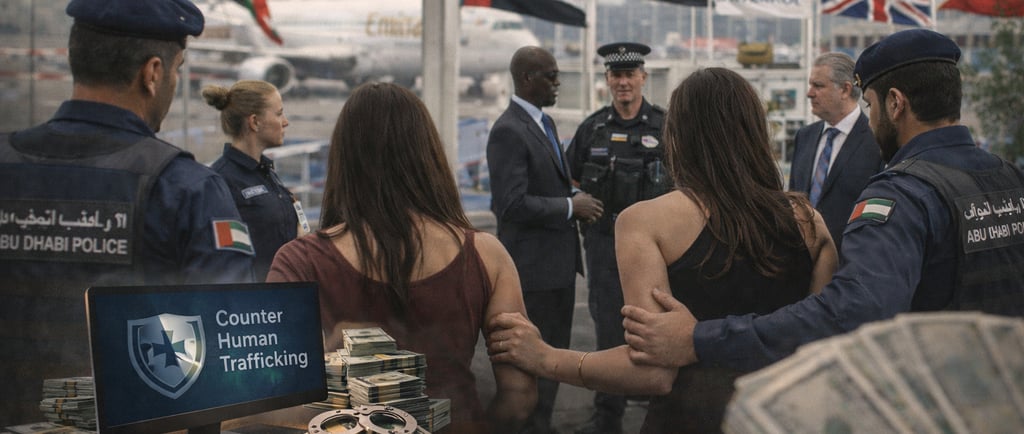

As the world marks World Day Against Trafficking in Persons on July 30, the United Arab Emirates has reaffirmed its commitment to combating human trafficking as a serious violation of human dignity and international law.
In a statement marking the occasion, Abdullah Sultan bin Awad Al Nuaimi, UAE Minister of Justice and Chairman of the National Committee to Combat Human Trafficking, underscored the country’s determination to confront trafficking through a comprehensive legal, institutional, and technological framework.
Al Nuaimi highlighted the UAE’s continued investment in an integrated national digital justice system, built on principles of transparency, accountability, and human rights protection. The system increasingly relies on advanced technologies, including artificial intelligence, to improve case handling, enhance coordination between authorities, and reduce delays in victim support and judicial proceedings.
“These efforts aim to ease the suffering of victims and ensure that perpetrators are brought to justice swiftly and effectively,” he said.
International Cooperation as a Core Strategy
The minister emphasized that combating human trafficking cannot be achieved by individual states acting alone. The UAE continues to expand international partnerships with governments, UN agencies, and global organisations, facilitating the exchange of intelligence, expertise, and best practices.
According to Al Nuaimi, human trafficking is a transnational crime that evolves rapidly, requiring collective global action to dismantle networks that exploit vulnerable populations across borders.
Legal Framework and National Institutions
The UAE combats human trafficking through a multi-pillar approach encompassing:
Prevention
Prosecution
Punishment
Victim protection
International cooperation
The country was among the first in the region to join the UN Convention Against Transnational Organised Crime and its Protocol to Prevent, Suppress and Punish Trafficking in Persons, especially women and children. UAE legislation and enforcement mechanisms are aligned with these international standards.
Victim care and rehabilitation are provided through a nationwide network of institutions, including:
Ewa’a Shelters
Dubai Foundation for Women and Children (DFWAC)
Abu Dhabi Shelter and Humanitarian Care Center
Women Protection Center in Sharjah
These institutions offer shelter, medical and psychological care, legal assistance, and reintegration support.
Strengthened Penalties Under Federal Decree-Law No. (24) of 2023
Under Federal Decree-Law No. (24) of 2023, human trafficking is broadly defined to include:
Sexual exploitation and exploitation of prostitution
Forced labour and servitude
Slavery and practices similar to slavery
Organ or tissue removal
Forced begging
A trafficking offence is established where individuals are recruited, transported, harboured, or received through coercion, deception, abuse of vulnerability, or the exchange of benefits for exploitation. Crucially, the offence applies even without coercive means when the victim is a child or lacks legal capacity.
The law mandates:
A minimum prison sentence of five years
A minimum fine of AED 1 million
Legislative amendments currently under review aim to increase penalties further and expand victim protection mechanisms, ensuring the law keeps pace with evolving criminal methods.
Emerging Exploitation Models and Risk Indicators
While traditional trafficking often involves overt coercion, experts increasingly warn of more subtle exploitation models operating in high-income environments. These include arrangements where individuals—particularly women—become financially dependent on sponsors, intermediaries, or patrons through promises of lifestyle support, travel, accommodation, or legal assistance.
Such arrangements may not initially appear coercive but can evolve into situations of economic dependency, restricted autonomy, and exploitation, particularly where movement, income, or exit options are implicitly controlled. International anti-trafficking standards increasingly recognise abuse of vulnerability and power imbalance as key indicators of exploitation, even in the absence of physical confinement.
Authorities globally, including in the Gulf region, now monitor these patterns as part of broader efforts to detect and prevent non-traditional trafficking and exploitation schemes.
Reporting and Victim Support
The UAE encourages the public to report suspected trafficking cases through established channels, including:
SAVE800 hotline
Ewa’a shelters and websites
Dubai Police’s General Department of Human Rights
Social Support Centers under Abu Dhabi Police
Victims are entitled to protection, temporary residency, legal aid, medical care, and repatriation assistance where appropriate.
A Continuing Commitment
On World Day Against Trafficking in Persons, the UAE reiterated its commitment to eradicating human trafficking through strong laws, effective enforcement, victim-centered care, and international cooperation.
The country called on governments, civil society, and international institutions to strengthen collaboration and remain vigilant against both traditional and emerging forms of human exploitation.