
U.S. Treasury Targets Vast Sanctions Evasion Network Linked to Hizballah Financier
12/27/20253 min read
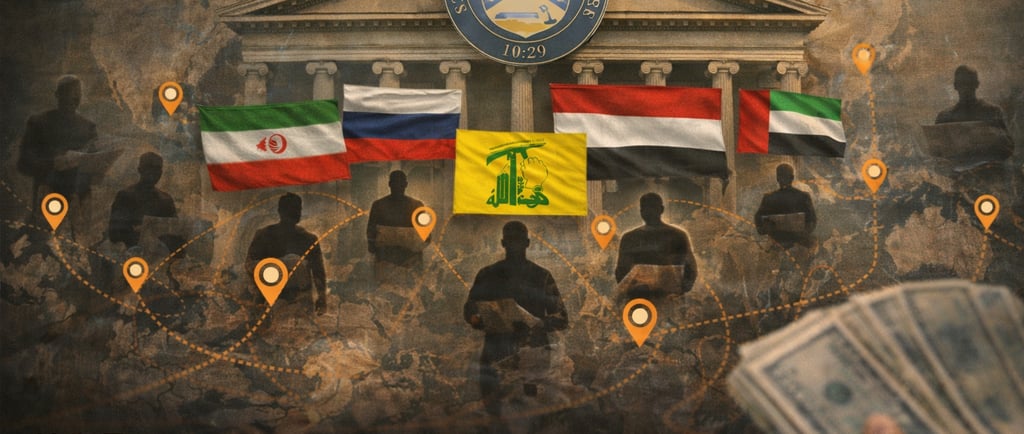
52 individuals and entities across nine countries designated in coordinated international action
The U.S. Department of the Treasury has announced one of its most expansive sanctions actions in recent years, designating 52 individuals and companies across nine countries for their roles in a global money laundering and sanctions evasion network supporting Hizballah financier Nazem Said Ahmad, a Specially Designated Global Terrorist since 2019.
The network, which spans Lebanon, the United Arab Emirates, South Africa, Angola, Côte d’Ivoire, the Democratic Republic of the Congo, Belgium, the United Kingdom, and Hong Kong, facilitated the movement of cash, diamonds, precious stones, artworks, and luxury goods to sustain Ahmad’s operations and lifestyle while bypassing international sanctions.
According to Treasury officials, the operation relied on shell companies, proxy ownership, falsified documentation, and exploitation of regulatory gaps in the global luxury goods and art markets.
“Luxury good market participants should be attentive to these schemes,” said Brian E. Nelson, Under Secretary of the Treasury for Terrorism and Financial Intelligence, warning that high-end assets continue to serve as conduits for terrorist financing and money laundering.
How the Network Operated
Treasury’s investigation reveals a sophisticated system designed to evade both Lebanese and international oversight:
Front companies registered across multiple jurisdictions
Bulk cash transfers and circular transactions
Undervaluation and overvaluation of art and diamonds
Use of family members and associates as proxy owners
Storage of large cash reserves outside formal banking systems
Leveraging weak enforcement at ports and free zones
Ahmad personally acquired more than $54 million in artworks since 2012, often concealing beneficial ownership through intermediaries, aliases, or nominee companies. Artworks and luxury goods were frequently moved through Dubai, Hong Kong, and European hubs, then imported into Lebanon with falsified invoices and manipulated customs declarations.
Treasury specifically highlighted how “layering”, a classic money laundering technique, was used to disconnect assets from their illicit origins through intra-network transfers and third-party accounts.
Lebanon, Dubai, and the Regional Risk Landscape
The designations underscore long-standing concerns about Lebanon’s cash-based economy and the use of Dubai-based entities as financial intermediaries. Treasury described how the network exploited permissive regulatory environments, particularly in the diamond, art, and luxury goods sectors, where beneficial ownership transparency remains limited.
The findings come amid heightened scrutiny of Lebanon’s financial system following its inclusion on multiple international watchlists and amid growing pressure on the country to strengthen anti–money laundering enforcement.
Wealth, Financial Opacity, and Exposure Risk
Independent investigative material reviewed alongside this case illustrates how private individuals operating across multiple jurisdictions can become entangled—directly or indirectly—in systems vulnerable to sanctions enforcement, even outside terrorist financing.
In one anonymised case involving a figure referred to here as Pamela, reviewed documentation shows extensive cross-border banking activity, asset acquisition in high-risk jurisdictions, reliance on intermediaries, and engagement with luxury markets similar to those identified in the Treasury action.
While no link to Hizballah or sanctioned entities has been established, the case highlights a growing reality: international enforcement efforts are increasingly focused not only on designated groups, but also on facilitators, intermediaries, and opaque financial behavior that mirrors known evasion techniques.
As sanctions enforcement expands, individuals with high-value assets, international mobility, and complex financial footprints—particularly in jurisdictions flagged for money laundering risks—face heightened exposure to account freezes, enhanced due diligence, and regulatory scrutiny, regardless of intent.
Sanctions Implications
Under Executive Order 13224:
All assets of designated persons within U.S. jurisdiction are blocked
Any entity 50% or more owned by a designated person is also blocked
U.S. persons are prohibited from conducting transactions involving these parties
Foreign financial institutions facilitating significant transactions risk secondary sanctions
Treasury emphasized that sanctions are designed not solely as punishment, but as a mechanism to force behavioral change and disrupt illicit financial ecosystems.
A Warning to Global Markets
The scope of this designation sends a clear message: luxury goods, art, and private wealth structures are no longer safe havens for illicit finance. As regulators tighten scrutiny, the line between legitimate asset management and sanctionable conduct is narrowing—particularly in regions where transparency has lagged behind capital flows.
For Lebanon and its regional partners, the implications extend beyond Hizballah. The case highlights how systemic financial opacity can expose entire economies—and private individuals within them—to international enforcement actions, long after the original actors are named.