
Why Sex Trafficking Thrives in Times of Economic Collapse and Conflict
1/22/20262 min read
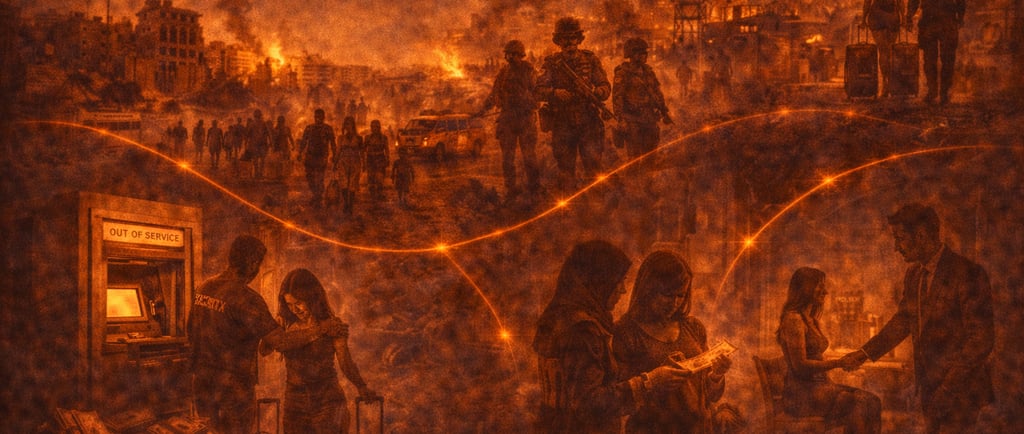
Sex trafficking does not emerge in a vacuum. It expands where systems break down, where survival becomes uncertain, and where law is enforced selectively. Across the Middle East and its surrounding regions, economic collapse and conflict have created precisely these conditions — turning instability into a renewable resource for exploitation.
From Lebanon’s financial implosion to Syria’s prolonged war, from displacement in Iraq to migration corridors through Turkey and into the Gulf, the same pattern repeats: crisis produces vulnerability, and vulnerability produces profit.
Collapse as a Recruitment Engine
Economic collapse strips people of choices.
When wages evaporate, savings disappear, and public services fail, survival becomes transactional. Traffickers do not need to coerce immediately; they only need to offer an alternative — any alternative — to starvation, homelessness, or debt.
Women and girls are disproportionately affected:
They are often last hired and first fired
They carry caregiving responsibilities
They face barriers to formal employment
They experience gender-based violence at higher rates
In crisis economies, sexual exploitation becomes framed as work rather than abuse.
Conflict and Displacement
War accelerates trafficking by dismantling social protections.
Displaced populations lose:
legal documentation
community oversight
access to education and healthcare
protection from authorities
Refugee camps and informal settlements become recruitment grounds. Traffickers pose as helpers, employers, or marriage brokers. Exploitation often begins with housing or transport — not sex.
Once displacement occurs, borders lose meaning. Victims are moved internally or across countries with minimal resistance.
Migration Without Protection
Migration is not the problem. Unprotected migration is.
When legal pathways to work are restricted, people move anyway — through informal channels. These channels are controlled by intermediaries who profit from desperation.
Visa systems, sponsorship regimes, and border controls often criminalize migrants rather than protect them. This legal precarity ensures silence.
Trafficking thrives where the law treats vulnerability as illegality.
The Normalization of Exploitation
In prolonged crises, exploitation becomes normalized.
Communities adjust expectations. Abuse becomes background noise. Authorities prioritize stability over justice.
What would once provoke outrage becomes “understandable.” This moral erosion is as damaging as physical violence.
Once normalized, exploitation no longer requires secrecy.
Demand Does Not Disappear in Crisis
Economic collapse does not eliminate demand for sex. In some contexts, it increases it.
Men with relative privilege — local elites, expatriates, officials, or foreign workers — retain purchasing power. The price of exploitation drops as desperation rises.
This imbalance fuels trafficking markets.
Weak Institutions, Strong Incentives
Conflict and collapse weaken institutions.
Police are underpaid. Courts are overwhelmed. Corruption becomes survival.
Traffickers adapt faster than states. They exploit gaps, bribe officials, and shift routes.
Enforcement becomes symbolic rather than systemic.
The Role of International Blind Spots
International responses often focus on humanitarian aid rather than structural reform.
Aid alleviates suffering but does not dismantle trafficking systems. Without labor protections, legal migration pathways, and victim-centered justice, exploitation re-emerges.
Crisis management becomes permanent policy.
Why Recovery Alone Is Not Enough
Economic recovery does not automatically end trafficking.
Once networks are established, they persist. Exploitation adapts to new conditions.
Unless accountability is enforced and protection guaranteed, trafficking survives recovery.
A Predictable Outcome
Sex trafficking thrives in crisis because it is rational within broken systems.
It offers income where none exists, mobility where borders close, and power where law fails.
This does not make it inevitable — but it does make it predictable.
The Real Question
The question is not why trafficking exists in collapse.
The question is why systems continue to treat collapse as temporary — while exploitation becomes permanent.